G:W1:3 5
Edit position
Edit position

Last set 9 hours, 59 minutes ago. Manual moves override automatic placement until the next shelfie/spine match.

The swerve : how the world became modern
Diagnose this book
Open in Vernon Browser

The swerve : how the world became modern

by Stephen Greenblatt

This book charts the fifteenth-century rediscovery of Lucretius's ancient philosophical poem, On the Nature of Things, analysing how its radical ideas about science and religion helped shape the Renaissance and modern Western thought.

Accession 6277 ISBN 0393064476 Publisher W. W. Norton & Co.
Book Images
Reference and live side by side Hover to see live images

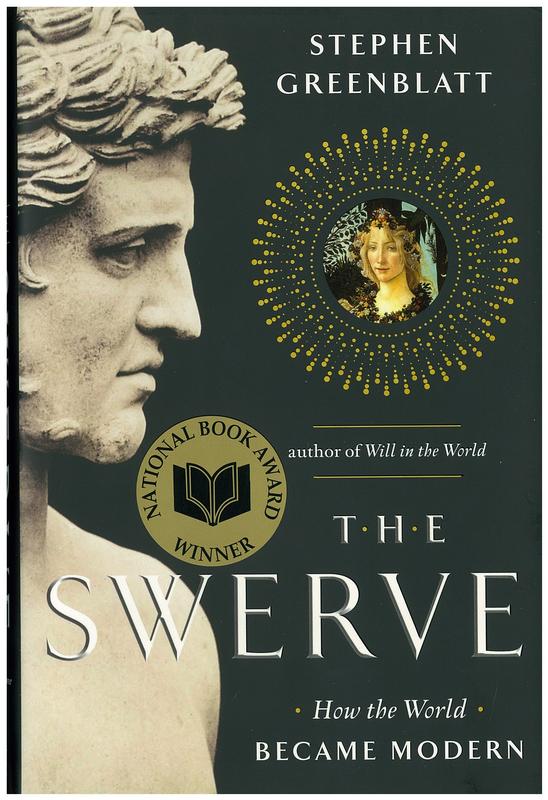
Reference
The swerve : how the world became modern spine
The swerve : how the world became modern cover
Live
The swerve : how the world became modern live spine
No live
The swerve : how the world became modern spine The swerve : how the world became modern live spine
The swerve : how the world became modern cover
No live
TAGS
Curated Derived
Culture Folklore History Philosophy Religion Science
CONNECTIONS
No connections
State
on_shelf
True
position_updated_at
2026-06-10 09:09
orientation
vertical
Details

Physical

binding_type
Hard Back
dimensions
244.00 (H) × 165.00 (W) × 33.00 (T) mm
spine_text
none captured

Metadata

Book form
LOCATION HISTORY
G:W1:3 5 Current vertical
1 week, 2 days ago
3 weeks, 2 days ago
4 weeks, 1 day ago
4 weeks, 1 day ago
Unknown location vertical
4 weeks, 2 days ago
Book Location
Updated 9 hours, 59 minutes ago
Vernon snapshot
View live

Frozen copy of Vernon's record from the last sync. Fields tagged flow back into the Pulse record.

Last synced 2026-05-21 00:37 (2 weeks, 6 days ago)

Identity

name→ title
The swerve : how the world became modern
vernon_id
10082
accession_no→ accession_number
6277
vernon_slug
the-swerve-how-the-world-became-modern-stephen-greenblatt

Drives Pulse state

curr_loc_status→ on_shelf
On Shelf
location_name
Zone W1 (Live bays)/Level 1/Phrontisterion/MONA
location_reason
On Shelf
isbn_issn→ isbn (when valid)
0393064476

Descriptive

production_date
2011
object_type
Books/Document genres/Information forms/Visual and Verbal Communication
object_status
Accessioned
brief_description
Winner of the 2012 Pulitzer Prize for Non-Fiction Winner of the 2011 National Book Award for Non-Fiction One of the world's most celebrated scholars, Stephen Greenblatt has crafted both an innovative work of history and a thrilling story of discovery, in which one manuscript, plucked from a thousand years of neglect, changed the course of human thought and made possible the world as we know it. Nearly six hundred years ago, a short, genial, cannily alert man in his late thirties took a very old manuscript off a library shelf, saw with excitement what he had discovered, and ordered that it be copied. That book was the last surviving manuscript of an ancient Roman philosophical epic, On the Nature of Things, by Lucretius―a beautiful poem of the most dangerous ideas: that the universe functioned without the aid of gods, that religious fear was damaging to human life, and that matter was made up of very small particles in eternal motion, colliding and swerving in new directions. The copying and translation of this ancient book-the greatest discovery of the greatest book-hunter of his age-fueled the Renaissance, inspiring artists such as Botticelli and thinkers such as Giordano Bruno; shaped the thought of Galileo and Freud, Darwin and Einstein; and had a revolutionary influence on writers such as Montaigne and Shakespeare and even Thomas Jefferson.

Subjects & people

authors→ author (initial fill only)
Stephen Greenblatt
tags→ tags
Science, Religion, History, Philosophy, Civilisation, Superstition
subject_people
Titus Lucretius Carus (b.99 BCE, d.55 BCE), Questio de rerum natura
subject_objects

Cover image

vernon_cover_image_id→ cover_image
19330

Raw Vernon JSON

click to inspect

The source payload behind the snapshot above.

Use ⌘F to search once expanded.
{7 keys}
"slug": "the-swerve-how-the-world-became-modern-stephen-greenblatt"
"opacObjectId": "10082"
"opacCollection": {1 keys}
"opacCollectionId": "1"
"imagesCollection": {2 keys}
"images": [1 items]
"[0]": {5 keys}
"imageId": "19330"
"cssColors": [3 items]
"[0]": {9 keys}
"hex": "d2b48c"
"hue": 34
"rank": 1
"presence": 29.0
"colorName": "tan"
"lightness": 69
"colorGroup": "brown"
"saturation": 44
"formattedColorName": "tan"
"[1]": {9 keys}
"hex": "708090"
"hue": 210
"rank": 2
"presence": 62.15
"colorName": "slategray"
"lightness": 50
"colorGroup": "gray"
"saturation": 13
"formattedColorName": "slate gray"
"[2]": {9 keys}
"hex": "696969"
"hue": 0
"rank": 3
"presence": 8.44
"colorName": "dimgray"
"lightness": 41
"colorGroup": "gray"
"saturation": 0
"formattedColorName": "dim gray"
"rawColors": [7 items]
"[0]": {6 keys}
"hex": "d4ccb2"
"hue": 45
"rank": 1
"presence": 29.0
"lightness": 76
"saturation": 28
"[1]": {6 keys}
"hex": "2c342e"
"hue": 135
"rank": 2
"presence": 62.15
"lightness": 18
"saturation": 8
"[2]": {6 keys}
"hex": "7d7a5c"
"hue": 54
"rank": 3
"presence": 8.44
"lightness": 42
"saturation": 15
"[3]": {6 keys}
"hex": "919f85"
"hue": 92
"rank": 4
"presence": 0.33
"lightness": 57
"saturation": 11
"[4]": {6 keys}
"hex": "5b6c53"
"hue": 100
"rank": 5
"presence": 0.08
"lightness": 37
"saturation": 13
"[5]": {6 keys}
"hex": "94949c"
"hue": 240
"rank": 6
"presence": 0.0
"lightness": 59
"saturation": 3
"[6]": {6 keys}
"hex": "9c6419"
"hue": 34
"rank": 7
"presence": 0.0
"lightness": 35
"saturation": 72
"imageLabels": [10 items]
"[0]": {5 keys}
"count": 553
"score": 96.78
"status": "auto_verified"
"imageLabel": "Chin"
"imageLabelId": 76
"[1]": {5 keys}
"count": 19411
"score": 82.82
"status": "auto_verified"
"imageLabel": "Font"
"imageLabelId": 12
"[2]": {5 keys}
"count": 11760
"score": 78.79
"status": "auto_verified"
"imageLabel": "Poster"
"imageLabelId": 21
"[3]": {5 keys}
"count": 19018
"score": 75.51
"status": "auto_verified"
"imageLabel": "Publication"
"imageLabelId": 23
"[4]": {5 keys}
"count": 15171
"score": 74.76
"status": "auto_verified"
"imageLabel": "Book"
"imageLabelId": 67
"[5]": {5 keys}
"count": 2836
"score": 67.11
"status": "auto_verified"
"imageLabel": "History"
"imageLabelId": 80
"[6]": {5 keys}
"count": 5931
"score": 64.79
"status": "auto_verified"
"imageLabel": "Illustration"
"imageLabelId": 25
"[7]": {5 keys}
"count": 12694
"score": 64.48
"status": "auto_verified"
"imageLabel": "Book cover"
"imageLabelId": 90
"[8]": {5 keys}
"count": 5351
"score": 61.68
"status": "auto_verified"
"imageLabel": "Advertising"
"imageLabelId": 71
"[9]": {5 keys}
"count": 101
"score": 59.39
"status": "auto_verified"
"imageLabel": "Signature"
"imageLabelId": 137
"imageDerivatives": [6 items]
"[0]": {4 keys}
"url": "https://browser.mona.net.au/records/images/large/90/582a91223216be087ffa6e830cbac4d71e876315.jpg"
"width": "548"
"height": "800"
"identifier": "LARGE"
"[1]": {4 keys}
"url": "https://browser.mona.net.au/records/images/medium/90/582a91223216be087ffa6e830cbac4d71e876315.jpg"
"width": "274"
"height": "400"
"identifier": "MEDIUM"
"[2]": {4 keys}
"url": "https://browser.mona.net.au/records/images/nano/90/582a91223216be087ffa6e830cbac4d71e876315.jpg"
"width": "24"
"height": "35"
"identifier": "NANO"
"[3]": {4 keys}
"url": "https://browser.mona.net.au/records/images/small/90/582a91223216be087ffa6e830cbac4d71e876315.jpg"
"width": "103"
"height": "150"
"identifier": "SMALL"
"[4]": {4 keys}
"url": "https://browser.mona.net.au/records/images/tiny/90/582a91223216be087ffa6e830cbac4d71e876315.jpg"
"width": "51"
"height": "75"
"identifier": "TINY"
"[5]": {4 keys}
"url": "https://browser.mona.net.au/records/images/xlarge/90/582a91223216be087ffa6e830cbac4d71e876315.jpg"
"width": "822"
"height": "1200"
"identifier": "XLARGE"
"totalImages": 1
"objectSearchScore": 0.3118719
"opacObjectFieldSets": [40 items]
"[0]": {2 keys}
"identifier": "accession_no"
"opacObjectFields": [1 items]
"[0]": {1 keys}
"value": "6277"
"[1]": {2 keys}
"identifier": "name"
"opacObjectFields": [1 items]
"[0]": {2 keys}
"value": "The swerve : how the world became modern / Stephen Greenblatt"
"opacObjectFieldAttributes": [1 items]
"[0]": {2 keys}
"key": "title"
"value": "The swerve : how the world became modern / Stephen Greenblatt"
"[2]": {2 keys}
"identifier": "other_name"
"opacObjectFields": [1 items]
"[0]": {1 keys}
"value": "The swerve : how the Renaissance began"
"[3]": {2 keys}
"identifier": "artist_last_first"
"opacObjectFields": [1 items]
"[0]": {1 keys}
"value": "Greenblatt, Stephen"
"[4]": {2 keys}
"identifier": "prod_pri_date"
"opacObjectFields": [1 items]
"[0]": {2 keys}
"value": "2011"
"opacObjectFieldAttributes": [2 items]
"[0]": {2 keys}
"key": "earliest_date"
"value": "2011-01-01Z"
"[1]": {2 keys}
"key": "latest_date"
"value": "2011-12-31Z"
"[5]": {2 keys}
"identifier": "prod_pri_date_notes"
"opacObjectFields": [1 items]
"[0]": {1 keys}
"value": ""
"[6]": {2 keys}
"identifier": "edition"
"opacObjectFields": [1 items]
"[0]": {1 keys}
"value": ""
"[7]": {2 keys}
"identifier": "brief_desc"
"opacObjectFields": [8 items]
"[0]": {1 keys}
"value": "Winner of the 2012 Pulitzer Prize for Non-Fiction"
"[1]": {1 keys}
"value": "Winner of the 2011 National Book Award for Non-Fiction"
"[2]": {1 keys}
"value": ""
"[3]": {1 keys}
"value": "One of the world's most celebrated scholars, Stephen Greenblatt has crafted both an innovative work of history and a thrilling story of discovery, in which one manuscript, plucked from a thousand years of neglect, changed the course of human thought and made possible the world as we know it."
"[4]": {1 keys}
"value": ""
"[5]": {1 keys}
"value": "Nearly six hundred years ago, a short, genial, cannily alert man in his late thirties took a very old manuscript off a library shelf, saw with excitement what he had discovered, and ordered that it be copied. That book was the last surviving manuscript of an ancient Roman philosophical epic, On the Nature of Things, by Lucretius―a beautiful poem of the most dangerous ideas: that the universe functioned without the aid of gods, that religious fear was damaging to human life, and that matter was made up of very small particles in eternal motion, colliding and swerving in new directions."
"[6]": {1 keys}
"value": ""
"[7]": {1 keys}
"value": "The copying and translation of this ancient book-the greatest discovery of the greatest book-hunter of his age-fueled the Renaissance, inspiring artists such as Botticelli and thinkers such as Giordano Bruno; shaped the thought of Galileo and Freud, Darwin and Einstein; and had a revolutionary influence on writers such as Montaigne and Shakespeare and even Thomas Jefferson."
"[8]": {2 keys}
"identifier": "measure_desc"
"opacObjectFields": [1 items]
"[0]": {1 keys}
"value": ""
"[9]": {2 keys}
"identifier": "credit_line"
"opacObjectFields": [1 items]
"[0]": {1 keys}
"value": ""
"[10]": {2 keys}
"identifier": "curr_loc_status"
"opacObjectFields": [1 items]
"[0]": {2 keys}
"value": "On Shelf"
"opacObjectFieldAttributes": [1 items]
"[0]": {2 keys}
"key": "search"
"value": "curr_loc_status:"On Shelf""
"[11]": {2 keys}
"identifier": "ob_status"
"opacObjectFields": [1 items]
"[0]": {1 keys}
"value": "Accessioned"
"[12]": {2 keys}
"identifier": "lender"
"opacObjectFields": [1 items]
"[0]": {1 keys}
"value": ""
"[13]": {2 keys}
"identifier": "copyright_owner"
"opacObjectFields": [1 items]
"[0]": {1 keys}
"value": ""
"[14]": {2 keys}
"identifier": "copyright_type"
"opacObjectFields": [1 items]
"[0]": {1 keys}
"value": ""
"[15]": {2 keys}
"identifier": "copyright_start"
"opacObjectFields": [0 items]
"[16]": {2 keys}
"identifier": "copyright_expiry"
"opacObjectFields": [0 items]
"[17]": {2 keys}
"identifier": "copyright_notes"
"opacObjectFields": [1 items]
"[0]": {1 keys}
"value": ""
"[18]": {2 keys}
"identifier": "curr_loc"
"opacObjectFields": [1 items]
"[0]": {1 keys}
"value": "Zone W1 (Live bays)/Level 1/Phrontisterion/MONA"
"[19]": {2 keys}
"identifier": "object_type"
"opacObjectFields": [1 items]
"[0]": {2 keys}
"value": "Books/Document genres/Information forms/Visual and Verbal Communication"
"opacObjectFieldAttributes": [1 items]
"[0]": {2 keys}
"key": "search"
"value": "object_type:"Books/Document genres/Information forms/Visual and Verbal Communication""
"[20]": {2 keys}
"identifier": "collection"
"opacObjectFields": [1 items]
"[0]": {2 keys}
"value": "Main Collection/Library"
"opacObjectFieldAttributes": [1 items]
"[0]": {2 keys}
"key": "search"
"value": "collection:"Main Collection/Library""
"[21]": {2 keys}
"identifier": "prod_pri_place"
"opacObjectFields": [1 items]
"[0]": {1 keys}
"value": "New York City/New York/United States of America"
"[22]": {2 keys}
"identifier": "prod_pri_publisher"
"opacObjectFields": [1 items]
"[0]": {1 keys}
"value": "W. W. Norton & Co."
"[23]": {2 keys}
"identifier": "physical_notes"
"opacObjectFields": [2 items]
"[0]": {1 keys}
"value": "356 pages : illustration ; 25 cm."
"[1]": {1 keys}
"value": "Includes bibliographical references & index."
"[24]": {2 keys}
"identifier": "language"
"opacObjectFields": [1 items]
"[0]": {1 keys}
"value": "English"
"[25]": {2 keys}
"identifier": "isbn_issn"
"opacObjectFields": [1 items]
"[0]": {1 keys}
"value": "0393064476"
"[26]": {2 keys}
"identifier": "user_sym_1"
"opacObjectFields": [1 items]
"[0]": {1 keys}
"value": "940.21 GRE"
"[27]": {2 keys}
"identifier": "usual_loc_being"
"opacObjectFields": [1 items]
"[0]": {1 keys}
"value": "Zone W1 (Live bays)/Level 1/Phrontisterion/MONA"
"[28]": {2 keys}
"identifier": "subject_class"
"opacObjectFields": [5 items]
"[0]": {2 keys}
"value": "Civilisation"
"opacObjectFieldAttributes": [1 items]
"[0]": {2 keys}
"key": "search"
"value": "subject_class:"Civilisation""
"[1]": {2 keys}
"value": "History"
"opacObjectFieldAttributes": [1 items]
"[0]": {2 keys}
"key": "search"
"value": "subject_class:"History""
"[2]": {2 keys}
"value": "Philosophy"
"opacObjectFieldAttributes": [1 items]
"[0]": {2 keys}
"key": "search"
"value": "subject_class:"Philosophy""
"[3]": {2 keys}
"value": "Science"
"opacObjectFieldAttributes": [1 items]
"[0]": {2 keys}
"key": "search"
"value": "subject_class:"Science""
"[4]": {2 keys}
"value": "Superstition/Religion"
"opacObjectFieldAttributes": [1 items]
"[0]": {2 keys}
"key": "search"
"value": "subject_class:"Superstition/Religion""
"[29]": {2 keys}
"identifier": "subject_date"
"opacObjectFields": [0 items]
"[30]": {2 keys}
"identifier": "subject_event"
"opacObjectFields": [1 items]
"[0]": {1 keys}
"value": ""
"[31]": {2 keys}
"identifier": "subject_period"
"opacObjectFields": [1 items]
"[0]": {1 keys}
"value": ""
"[32]": {2 keys}
"identifier": "subject_object"
"opacObjectFields": [1 items]
"[0]": {1 keys}
"value": ""
"[33]": {2 keys}
"identifier": "subject_person"
"opacObjectFields": [2 items]
"[0]": {2 keys}
"value": "Titus Lucretius Carus (b.99 BCE, d.55 BCE)"
"opacObjectFieldAttributes": [1 items]
"[0]": {2 keys}
"key": "search"
"value": "subject_person:"Titus Lucretius Carus (b.99 BCE, d.55 BCE)""
"[1]": {2 keys}
"value": "Questio de rerum natura"
"opacObjectFieldAttributes": [1 items]
"[0]": {2 keys}
"key": "search"
"value": "subject_person:"Questio de rerum natura""
"[34]": {2 keys}
"identifier": "subject_place"
"opacObjectFields": [1 items]
"[0]": {1 keys}
"value": ""
"[35]": {2 keys}
"identifier": "assoc_person"
"opacObjectFields": [1 items]
"[0]": {1 keys}
"value": ""
"[36]": {2 keys}
"identifier": "assoc_place"
"opacObjectFields": [1 items]
"[0]": {1 keys}
"value": ""
"[37]": {2 keys}
"identifier": "assoc_event"
"opacObjectFields": [1 items]
"[0]": {1 keys}
"value": ""
"[38]": {2 keys}
"identifier": "assoc_object"
"opacObjectFields": [1 items]
"[0]": {1 keys}
"value": ""
"[39]": {2 keys}
"identifier": "user_sym_9"
"opacObjectFields": [1 items]
"[0]": {1 keys}
"value": ""
"relationshipsCollection": {2 keys}
"relationships": [1 items]
"[0]": {4 keys}
"relatedRecords": [1 items]
"[0]": {3 keys}
"slug": "stephen-greenblatt"
"title": "Stephen Greenblatt"
"relatedRecordId": "12500"
"relationshipId": "object_prod_pri_person"
"relatedRecordType": "person"
"totalRelatedRecords": 1
"totalRelationships": 1
Topics and Themes
