Withdrawn
Edit position
Edit position

No position recorded yet. Picking a shelf here sets the manual override.

Behavioral ecology and the transition to agriculture
Diagnose this book
Open in Vernon Browser

Behavioral ecology and the transition to agriculture

by Douglas J. Kennett, Bruce Winterhalder

This volume uses human behavioural ecology to explore the transition from hunting and gathering to agriculture. Drawing on global ethnographic and archaeological case studies, it analyses how human subsistence systems evolved.

Accession 4381 ISBN 0520246470 Publisher University of California Press
Book Images
Reference and live side by side Hover to see live images

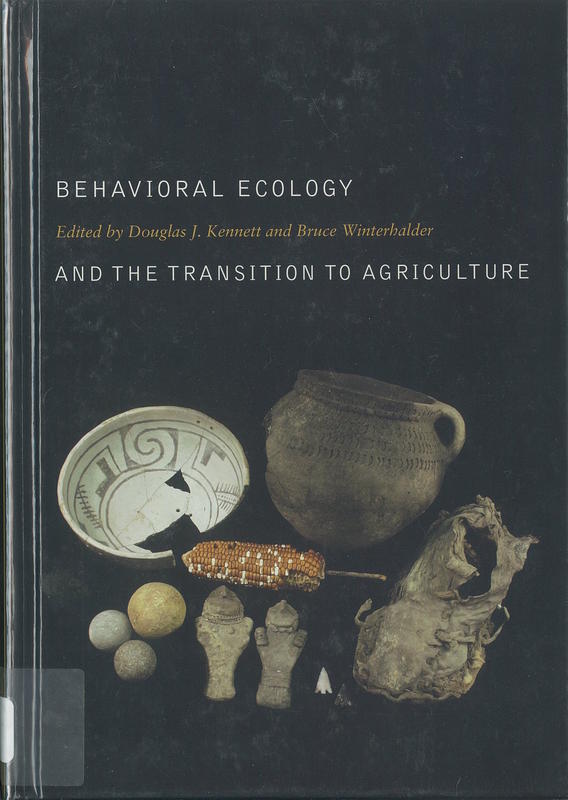
Reference
Behavioral ecology and the transition to agriculture spine
Behavioral ecology and the transition to agriculture cover
Live
No live
No live
Behavioral ecology and the transition to agriculture spine
No live
Behavioral ecology and the transition to agriculture cover
No live
TAGS
Curated Derived
Animals Archaeology Culture Economics Evolution Food and Drink History Humankind Plants Psychology Social Sciences The Past
CONNECTIONS
No connections
State
on_shelf
False
position_updated_at
never
orientation
unknown
Details

Physical

binding_type
Hard Back
dimensions
none captured
spine_text
none captured

Metadata

Book form
LOCATION HISTORY
No location history available for this book.
Vernon snapshot
View live

Frozen copy of Vernon's record from the last sync. Fields tagged flow back into the Pulse record.

Last synced 2026-05-21 12:00 (2 weeks, 6 days ago)

Identity

name→ title
Behavioral ecology and the transition to agriculture
vernon_id
8192
accession_no→ accession_number
4381
vernon_slug
behavioral-ecology-and-the-transition-to-agriculture-edited-by-douglas-j-kennett-and-bruce-winterhalder

Drives Pulse state

curr_loc_status→ on_shelf
Storage
location_name
Rare Book compactus/Rare Book Storage Room (RBS)/Level 2 (Mezzanine)/Phrontisterion/MONA
location_reason
Storage
isbn_issn→ isbn (when valid)
0520246470

Descriptive

production_date
2006
object_type
Books/Document genres/Information forms/Visual and Verbal Communication
object_status
Accessioned
brief_description
This volume is the first collective effort by archaeologists and ethnographers to use concepts and models from human behavioral ecology to explore one of the most consequential transitions in human history: the origins of agriculture. Carefully balancing theory and detailed empirical study, and drawing from a series of ethnographic and archaeological case studies from eleven locations - including North and South America, Mesoamerica, Europe, the Near East, Africa, and the Pacific - the contributors examine the transition from hunting and gathering to farming and herding using a broad set of analytical models and concepts. These include diet breadth, central place foraging, ideal free distribution, discounting, risk sensitivity, population ecology, and costly signaling. An introductory chapter both charts the basics of the theory and notes areas of rapid advance in our understanding of how human subsistence systems evolve. Two concluding chapters by senior archaeologists reflect on the potential for human behavioral ecology to explain domestication and the transition from foraging to farming.

Subjects & people

authors→ author (initial fill only)
Douglas J. Kennett, Bruce Winterhalder
tags→ tags
Psychology, History, Archaeology, Social sciences, Civilisation, Anthropology, Agriculture, Economics, Animals, Food, Evolutionary psychology, Animal behaviour -- Evolution, Behaviour evolution
subject_people
subject_objects

Cover image

vernon_cover_image_id→ cover_image
18881

Raw Vernon JSON

click to inspect

The source payload behind the snapshot above.

Use ⌘F to search once expanded.
{7 keys}
"slug": "behavioral-ecology-and-the-transition-to-agriculture-edited-by-douglas-j-kennett-and-bruce-winterhalder"
"opacObjectId": "8192"
"opacCollection": {1 keys}
"opacCollectionId": "1"
"imagesCollection": {2 keys}
"images": [1 items]
"[0]": {5 keys}
"imageId": "18881"
"cssColors": [4 items]
"[0]": {9 keys}
"hex": "708090"
"hue": 210
"rank": 1
"presence": 84.35
"colorName": "slategray"
"lightness": 50
"colorGroup": "gray"
"saturation": 13
"formattedColorName": "slate gray"
"[1]": {9 keys}
"hex": "a9a9a9"
"hue": 0
"rank": 2
"presence": 5.07
"colorName": "darkgray"
"lightness": 66
"colorGroup": "gray"
"saturation": 0
"formattedColorName": "dark gray"
"[2]": {9 keys}
"hex": "696969"
"hue": 0
"rank": 3
"presence": 7.95
"colorName": "dimgray"
"lightness": 41
"colorGroup": "gray"
"saturation": 0
"formattedColorName": "dim gray"
"[3]": {9 keys}
"hex": "808080"
"hue": 0
"rank": 4
"presence": 0.92
"colorName": "gray"
"lightness": 50
"colorGroup": "gray"
"saturation": 0
"formattedColorName": "gray"
"rawColors": [7 items]
"[0]": {6 keys}
"hex": "36393d"
"hue": 214
"rank": 1
"presence": 84.35
"lightness": 22
"saturation": 6
"[1]": {6 keys}
"hex": "b1b1a0"
"hue": 60
"rank": 2
"presence": 5.07
"lightness": 66
"saturation": 9
"[2]": {6 keys}
"hex": "7c7867"
"hue": 48
"rank": 3
"presence": 7.95
"lightness": 44
"saturation": 9
"[3]": {6 keys}
"hex": "919583"
"hue": 73
"rank": 4
"presence": 0.92
"lightness": 54
"saturation": 7
"[4]": {6 keys}
"hex": "929a9e"
"hue": 200
"rank": 5
"presence": 0.21
"lightness": 59
"saturation": 5
"[5]": {6 keys}
"hex": "616458"
"hue": 75
"rank": 6
"presence": 1.09
"lightness": 36
"saturation": 6
"[6]": {6 keys}
"hex": "62696e"
"hue": 205
"rank": 7
"presence": 0.41
"lightness": 40
"saturation": 5
"imageLabels": [10 items]
"[0]": {5 keys}
"count": 19411
"score": 79.21
"status": "auto_verified"
"imageLabel": "Font"
"imageLabelId": 12
"[1]": {5 keys}
"count": 15171
"score": 74.47
"status": "auto_verified"
"imageLabel": "Book"
"imageLabelId": 67
"[2]": {5 keys}
"count": 11006
"score": 73.77
"status": "auto_verified"
"imageLabel": "Art"
"imageLabelId": 4
"[3]": {5 keys}
"count": 11760
"score": 71.66
"status": "auto_verified"
"imageLabel": "Poster"
"imageLabelId": 21
"[4]": {5 keys}
"count": 19018
"score": 67.99
"status": "auto_verified"
"imageLabel": "Publication"
"imageLabelId": 23
"[5]": {5 keys}
"count": 5351
"score": 65.79
"status": "auto_verified"
"imageLabel": "Advertising"
"imageLabelId": 71
"[6]": {5 keys}
"count": 2395
"score": 65.66
"status": "auto_verified"
"imageLabel": "Event"
"imageLabelId": 46
"[7]": {5 keys}
"count": 2836
"score": 65.15
"status": "auto_verified"
"imageLabel": "History"
"imageLabelId": 80
"[8]": {5 keys}
"count": 2523
"score": 62.84
"status": "auto_verified"
"imageLabel": "Metal"
"imageLabelId": 9
"[9]": {5 keys}
"count": 12694
"score": 62.77
"status": "auto_verified"
"imageLabel": "Book cover"
"imageLabelId": 90
"imageDerivatives": [6 items]
"[0]": {4 keys}
"url": "https://browser.mona.net.au/records/images/large/16434/c1ad0f08b4ec290afaffc0f0fcd6e07aaee277b3.jpg"
"width": "568"
"height": "800"
"identifier": "LARGE"
"[1]": {4 keys}
"url": "https://browser.mona.net.au/records/images/medium/16434/c1ad0f08b4ec290afaffc0f0fcd6e07aaee277b3.jpg"
"width": "284"
"height": "400"
"identifier": "MEDIUM"
"[2]": {4 keys}
"url": "https://browser.mona.net.au/records/images/nano/16434/c1ad0f08b4ec290afaffc0f0fcd6e07aaee277b3.jpg"
"width": "25"
"height": "35"
"identifier": "NANO"
"[3]": {4 keys}
"url": "https://browser.mona.net.au/records/images/small/16434/c1ad0f08b4ec290afaffc0f0fcd6e07aaee277b3.jpg"
"width": "106"
"height": "150"
"identifier": "SMALL"
"[4]": {4 keys}
"url": "https://browser.mona.net.au/records/images/tiny/16434/c1ad0f08b4ec290afaffc0f0fcd6e07aaee277b3.jpg"
"width": "53"
"height": "75"
"identifier": "TINY"
"[5]": {4 keys}
"url": "https://browser.mona.net.au/records/images/xlarge/16434/c1ad0f08b4ec290afaffc0f0fcd6e07aaee277b3.jpg"
"width": "852"
"height": "1200"
"identifier": "XLARGE"
"totalImages": 1
"objectSearchScore": 1.3125268
"opacObjectFieldSets": [40 items]
"[0]": {2 keys}
"identifier": "accession_no"
"opacObjectFields": [1 items]
"[0]": {1 keys}
"value": "4381"
"[1]": {2 keys}
"identifier": "name"
"opacObjectFields": [1 items]
"[0]": {2 keys}
"value": "Behavioral ecology and the transition to agriculture /​ edited by Douglas J. Kennett and Bruce Winterhalder"
"opacObjectFieldAttributes": [1 items]
"[0]": {2 keys}
"key": "title"
"value": "Behavioral ecology and the transition to agriculture /​ edited by Douglas J. Kennett and Bruce Winterhalder"
"[2]": {2 keys}
"identifier": "other_name"
"opacObjectFields": [1 items]
"[0]": {1 keys}
"value": ""
"[3]": {2 keys}
"identifier": "artist_last_first"
"opacObjectFields": [2 items]
"[0]": {1 keys}
"value": "Kennett, Douglas J."
"[1]": {1 keys}
"value": "Winterhalder, Bruce"
"[4]": {2 keys}
"identifier": "prod_pri_date"
"opacObjectFields": [1 items]
"[0]": {2 keys}
"value": "2006"
"opacObjectFieldAttributes": [2 items]
"[0]": {2 keys}
"key": "earliest_date"
"value": "2006-01-01Z"
"[1]": {2 keys}
"key": "latest_date"
"value": "2006-12-31Z"
"[5]": {2 keys}
"identifier": "prod_pri_date_notes"
"opacObjectFields": [1 items]
"[0]": {1 keys}
"value": ""
"[6]": {2 keys}
"identifier": "edition"
"opacObjectFields": [1 items]
"[0]": {1 keys}
"value": ""
"[7]": {2 keys}
"identifier": "brief_desc"
"opacObjectFields": [2 items]
"[0]": {1 keys}
"value": "This volume is the first collective effort by archaeologists and ethnographers to use concepts and models from human behavioral ecology to explore one of the most consequential transitions in human history: the origins of agriculture. Carefully balancing theory and detailed empirical study, and drawing from a series of ethnographic and archaeological case studies from eleven locations - including North and South America, Mesoamerica, Europe, the Near East, Africa, and the Pacific - the contributors examine the transition from hunting and gathering to farming and herding using a broad set of analytical models and concepts. These include diet breadth, central place foraging, ideal free distribution, discounting, risk sensitivity, population ecology, and costly signaling. An introductory chapter both charts the basics of the theory and notes areas of rapid advance in our understanding of how human subsistence systems evolve."
"[1]": {1 keys}
"value": "Two concluding chapters by senior archaeologists reflect on the potential for human behavioral ecology to explain domestication and the transition from foraging to farming."
"[8]": {2 keys}
"identifier": "measure_desc"
"opacObjectFields": [1 items]
"[0]": {1 keys}
"value": ""
"[9]": {2 keys}
"identifier": "credit_line"
"opacObjectFields": [1 items]
"[0]": {1 keys}
"value": ""
"[10]": {2 keys}
"identifier": "curr_loc_status"
"opacObjectFields": [1 items]
"[0]": {2 keys}
"value": "Storage"
"opacObjectFieldAttributes": [1 items]
"[0]": {2 keys}
"key": "search"
"value": "curr_loc_status:"Storage""
"[11]": {2 keys}
"identifier": "ob_status"
"opacObjectFields": [1 items]
"[0]": {1 keys}
"value": "Accessioned"
"[12]": {2 keys}
"identifier": "lender"
"opacObjectFields": [1 items]
"[0]": {1 keys}
"value": ""
"[13]": {2 keys}
"identifier": "copyright_owner"
"opacObjectFields": [1 items]
"[0]": {1 keys}
"value": ""
"[14]": {2 keys}
"identifier": "copyright_type"
"opacObjectFields": [1 items]
"[0]": {1 keys}
"value": ""
"[15]": {2 keys}
"identifier": "copyright_start"
"opacObjectFields": [0 items]
"[16]": {2 keys}
"identifier": "copyright_expiry"
"opacObjectFields": [0 items]
"[17]": {2 keys}
"identifier": "copyright_notes"
"opacObjectFields": [1 items]
"[0]": {1 keys}
"value": ""
"[18]": {2 keys}
"identifier": "curr_loc"
"opacObjectFields": [1 items]
"[0]": {1 keys}
"value": "Rare Book compactus/Rare Book Storage Room (RBS)/Level 2 (Mezzanine)/Phrontisterion/MONA"
"[19]": {2 keys}
"identifier": "object_type"
"opacObjectFields": [1 items]
"[0]": {2 keys}
"value": "Books/Document genres/Information forms/Visual and Verbal Communication"
"opacObjectFieldAttributes": [1 items]
"[0]": {2 keys}
"key": "search"
"value": "object_type:"Books/Document genres/Information forms/Visual and Verbal Communication""
"[20]": {2 keys}
"identifier": "collection"
"opacObjectFields": [1 items]
"[0]": {2 keys}
"value": "Main Collection/Library"
"opacObjectFieldAttributes": [1 items]
"[0]": {2 keys}
"key": "search"
"value": "collection:"Main Collection/Library""
"[21]": {2 keys}
"identifier": "prod_pri_place"
"opacObjectFields": [1 items]
"[0]": {1 keys}
"value": "Berkeley/California/United States of America"
"[22]": {2 keys}
"identifier": "prod_pri_publisher"
"opacObjectFields": [1 items]
"[0]": {1 keys}
"value": "University of California Press"
"[23]": {2 keys}
"identifier": "physical_notes"
"opacObjectFields": [2 items]
"[0]": {1 keys}
"value": "xiii, 394 pages : illustrations ; 27 cm."
"[1]": {1 keys}
"value": "Includes bibliographical references and index."
"[24]": {2 keys}
"identifier": "language"
"opacObjectFields": [1 items]
"[0]": {1 keys}
"value": "English"
"[25]": {2 keys}
"identifier": "isbn_issn"
"opacObjectFields": [1 items]
"[0]": {1 keys}
"value": "0520246470"
"[26]": {2 keys}
"identifier": "user_sym_1"
"opacObjectFields": [1 items]
"[0]": {1 keys}
"value": "306.364 BEH"
"[27]": {2 keys}
"identifier": "usual_loc_being"
"opacObjectFields": [1 items]
"[0]": {1 keys}
"value": "Zone N3/Level 2 (Mezzanine)/Phrontisterion/MONA"
"[28]": {2 keys}
"identifier": "subject_class"
"opacObjectFields": [8 items]
"[0]": {2 keys}
"value": "History"
"opacObjectFieldAttributes": [1 items]
"[0]": {2 keys}
"key": "search"
"value": "subject_class:"History""
"[1]": {2 keys}
"value": "Archaeology/History"
"opacObjectFieldAttributes": [1 items]
"[0]": {2 keys}
"key": "search"
"value": "subject_class:"Archaeology/History""
"[2]": {2 keys}
"value": "Agriculture"
"opacObjectFieldAttributes": [1 items]
"[0]": {2 keys}
"key": "search"
"value": "subject_class:"Agriculture""
"[3]": {2 keys}
"value": "Anthropology"
"opacObjectFieldAttributes": [1 items]
"[0]": {2 keys}
"key": "search"
"value": "subject_class:"Anthropology""
"[4]": {2 keys}
"value": "Animals"
"opacObjectFieldAttributes": [1 items]
"[0]": {2 keys}
"key": "search"
"value": "subject_class:"Animals""
"[5]": {2 keys}
"value": "Food"
"opacObjectFieldAttributes": [1 items]
"[0]": {2 keys}
"key": "search"
"value": "subject_class:"Food""
"[6]": {2 keys}
"value": "Animal behaviour -- Evolution/Behaviour evolution/Evolutionary psychology/Psychology"
"opacObjectFieldAttributes": [1 items]
"[0]": {2 keys}
"key": "search"
"value": "subject_class:"Animal behaviour -- Evolution/Behaviour evolution/Evolutionary psychology/Psychology""
"[7]": {2 keys}
"value": "Economics/Social sciences/Civilisation"
"opacObjectFieldAttributes": [1 items]
"[0]": {2 keys}
"key": "search"
"value": "subject_class:"Economics/Social sciences/Civilisation""
"[29]": {2 keys}
"identifier": "subject_date"
"opacObjectFields": [0 items]
"[30]": {2 keys}
"identifier": "subject_event"
"opacObjectFields": [1 items]
"[0]": {1 keys}
"value": ""
"[31]": {2 keys}
"identifier": "subject_period"
"opacObjectFields": [1 items]
"[0]": {1 keys}
"value": ""
"[32]": {2 keys}
"identifier": "subject_object"
"opacObjectFields": [1 items]
"[0]": {1 keys}
"value": ""
"[33]": {2 keys}
"identifier": "subject_person"
"opacObjectFields": [1 items]
"[0]": {1 keys}
"value": ""
"[34]": {2 keys}
"identifier": "subject_place"
"opacObjectFields": [1 items]
"[0]": {1 keys}
"value": ""
"[35]": {2 keys}
"identifier": "assoc_person"
"opacObjectFields": [1 items]
"[0]": {1 keys}
"value": ""
"[36]": {2 keys}
"identifier": "assoc_place"
"opacObjectFields": [1 items]
"[0]": {1 keys}
"value": ""
"[37]": {2 keys}
"identifier": "assoc_event"
"opacObjectFields": [1 items]
"[0]": {1 keys}
"value": ""
"[38]": {2 keys}
"identifier": "assoc_object"
"opacObjectFields": [1 items]
"[0]": {1 keys}
"value": ""
"[39]": {2 keys}
"identifier": "user_sym_9"
"opacObjectFields": [1 items]
"[0]": {1 keys}
"value": ""
"relationshipsCollection": {2 keys}
"relationships": [1 items]
"[0]": {4 keys}
"relatedRecords": [2 items]
"[0]": {3 keys}
"slug": "douglas-j-kennett"
"title": "Douglas J. Kennett"
"relatedRecordId": "11339"
"[1]": {3 keys}
"slug": "bruce-winterhalder"
"title": "Bruce Winterhalder"
"relatedRecordId": "16453"
"relationshipId": "object_prod_pri_person"
"relatedRecordType": "person"
"totalRelatedRecords": 2
"totalRelationships": 1
Topics and Themes