M:N3:31 4
Edit position
Edit position

Last set 1 week, 1 day ago. Manual moves override automatic placement until the next shelfie/spine match.

Behave : the biology of humans at our best and worst
Diagnose this book
Open in Vernon Browser

Behave : the biology of humans at our best and worst

by Robert M. Sapolsky

This multidisciplinary study explores the biological and environmental factors that shape human behaviour, from immediate neural responses to long-term evolutionary and cultural influences.

Accession 13066 ISBN 9781847922168 Publisher Bodley Head (firm)
Book Images
Reference and live side by side Hover to see live images
Reference
Behave : the biology of humans at our best and worst spine
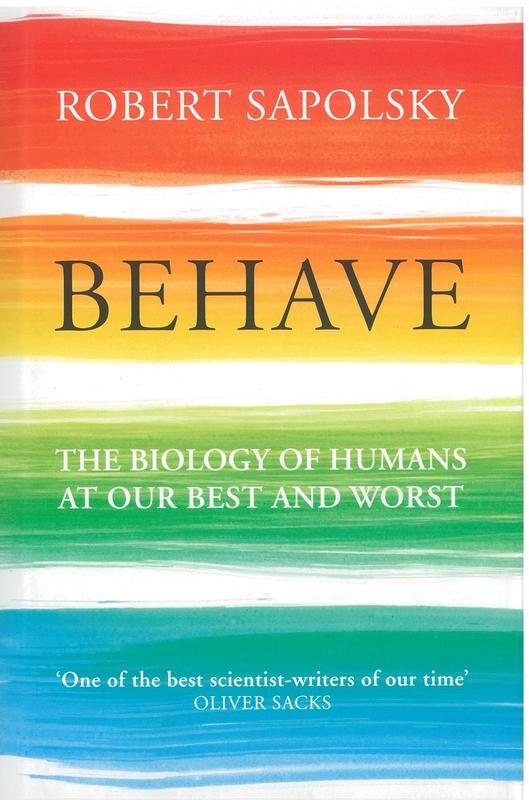
Behave : the biology of humans at our best and worst cover
Live
Behave : the biology of humans at our best and worst live spine
No live
Behave : the biology of humans at our best and worst spine Behave : the biology of humans at our best and worst live spine
Behave : the biology of humans at our best and worst cover
No live
TAGS
Curated Derived
Crime Culture Emotions Political Science Psychology Social Sciences
CONNECTIONS
No connections
State
on_shelf
True
position_updated_at
2026-06-01 16:44
orientation
vertical
Details

Physical

binding_type
Hard Back
dimensions
none captured
spine_text
none captured

Metadata

Book form
LOCATION HISTORY
M:N3:31 4 Current vertical
2 weeks ago
Book Location
Updated 1 week, 1 day ago
Vernon snapshot
View live

Frozen copy of Vernon's record from the last sync. Fields tagged flow back into the Pulse record.

Last synced 2026-05-21 00:59 (2 weeks, 6 days ago)

Identity

name→ title
Behave : the biology of humans at our best and worst
vernon_id
20489
accession_no→ accession_number
13066
vernon_slug
behave-the-biology-of-humans-at-our-best-and-worst-robert-m-sapolsky

Drives Pulse state

curr_loc_status→ on_shelf
On Shelf
location_name
Zone S3/Level 2 (Mezzanine)/Phrontisterion/MONA
location_reason
On Shelf
isbn_issn→ isbn (when valid)
9781847922168

Descriptive

production_date
2017
object_type
Books/Document genres/Information forms/Visual and Verbal Communication
object_status
Accessioned
brief_description
Sapolsky's storytelling concept is delightful but it also has a powerful intrinsic logic: he starts by looking at the factors that bear on a person's reaction in the precise moment a behavior occurs, and then hops back in time from there, in stages, ultimately ending up at the deep history of our species and its evolutionary legacy. And so the first category of explanation is the neurobiological one. A behavior occurs--whether an example of humans at our best, worst, or somewhere in between. What went on in a person's brain a second before the behavior happened? Then Sapolsky pulls out to a slightly larger field of vision, a little earlier in time: What sight, sound, or smell caused the nervous system to produce that behavior? And then, what hormones acted hours to days earlier to change how responsive that individual is to the stimuli that triggered the nervous system? By now he has increased our field of vision so that we are thinking about neurobiology and the sensory world of our environment and endocrinology in trying to explain what happened. Sapolsky keeps going: How was that behavior influenced by structural changes in the nervous system over the preceding months, by that person's adolescence, childhood, fetal life, and then back to his or her genetic makeup? Finally, he expands the view to encompass factors larger than one individual. How did culture shape that individual's group, what ecological factors millennia old formed that culture? And on and on, back to evolutionary factors millions of years old. The result is one of the most dazzling tours d'horizon of the science of human behavior ever attempted, a majestic synthesis that harvests cutting-edge research across a range of disciplines to provide a subtle and nuanced perspective on why we ultimately do the things we do...for good and for ill. Sapolsky builds on this understanding to wrestle with some of our deepest and thorniest questions relating to tribalism and xenophobia, hierarchy and competition, morality and free will, and war and peace. Wise, humane, often very funny, Behave is a towering achievement, powerfully humanizing, and downright heroic in its own right.

Subjects & people

authors→ author (initial fill only)
Robert M. Sapolsky
tags→ tags
Social psychology, Psychology, Social sciences, Civilisation, War, International relations, Violence, Evolutionary psychology, Human behaviour, Psychology, Applied, Behaviour evolution, Aggressiveness
subject_people
subject_objects

Cover image

vernon_cover_image_id→ cover_image
20707

Raw Vernon JSON

click to inspect

The source payload behind the snapshot above.

Use ⌘F to search once expanded.
{7 keys}
"slug": "behave-the-biology-of-humans-at-our-best-and-worst-robert-m-sapolsky"
"opacObjectId": "20489"
"opacCollection": {1 keys}
"opacCollectionId": "1"
"imagesCollection": {2 keys}
"images": [1 items]
"[0]": {5 keys}
"imageId": "20707"
"cssColors": [3 items]
"[0]": {9 keys}
"hex": "20b2aa"
"hue": 177
"rank": 1
"presence": 26.14
"colorName": "lightseagreen"
"lightness": 41
"colorGroup": "green"
"saturation": 70
"formattedColorName": "light sea green"
"[1]": {9 keys}
"hex": "cd853f"
"hue": 30
"rank": 2
"presence": 28.13
"colorName": "peru"
"lightness": 53
"colorGroup": "brown"
"saturation": 59
"formattedColorName": "peru"
"[2]": {9 keys}
"hex": "f08080"
"hue": 0
"rank": 3
"presence": 7.73
"colorName": "lightcoral"
"lightness": 72
"colorGroup": "red"
"saturation": 79
"formattedColorName": "light coral"
"rawColors": [7 items]
"[0]": {6 keys}
"hex": "29aea8"
"hue": 177
"rank": 1
"presence": 26.14
"lightness": 42
"saturation": 61
"[1]": {6 keys}
"hex": "e0924c"
"hue": 28
"rank": 2
"presence": 28.13
"lightness": 58
"saturation": 70
"[2]": {6 keys}
"hex": "e9f2ef"
"hue": 160
"rank": 3
"presence": 25.44
"lightness": 93
"saturation": 25
"[3]": {6 keys}
"hex": "ee493f"
"hue": 3
"rank": 4
"presence": 7.73
"lightness": 59
"saturation": 83
"[4]": {6 keys}
"hex": "c5d59f"
"hue": 77
"rank": 5
"presence": 5.78
"lightness": 72
"saturation": 39
"[5]": {6 keys}
"hex": "e2db5f"
"hue": 56
"rank": 6
"presence": 5.52
"lightness": 62
"saturation": 69
"[6]": {6 keys}
"hex": "514e21"
"hue": 56
"rank": 7
"presence": 1.26
"lightness": 22
"saturation": 42
"imageLabels": [5 items]
"[0]": {5 keys}
"count": 19411
"score": 83.64
"status": "auto_verified"
"imageLabel": "Font"
"imageLabelId": 12
"[1]": {5 keys}
"count": 962
"score": 80.1
"status": "auto_verified"
"imageLabel": "Material property"
"imageLabelId": 184
"[2]": {5 keys}
"count": 19018
"score": 77.97
"status": "auto_verified"
"imageLabel": "Publication"
"imageLabelId": 23
"[3]": {5 keys}
"count": 10019
"score": 62.19
"status": "auto_verified"
"imageLabel": "Rectangle"
"imageLabelId": 11
"[4]": {5 keys}
"count": 178
"score": 58.16
"status": "auto_verified"
"imageLabel": "Screenshot"
"imageLabelId": 579
"imageDerivatives": [6 items]
"[0]": {4 keys}
"url": "https://browser.mona.net.au/records/images/large/6798/677e1f76fde8c671d17e0ba1498c18c7718f6e2a.jpg"
"width": "529"
"height": "800"
"identifier": "LARGE"
"[1]": {4 keys}
"url": "https://browser.mona.net.au/records/images/medium/6798/677e1f76fde8c671d17e0ba1498c18c7718f6e2a.jpg"
"width": "265"
"height": "400"
"identifier": "MEDIUM"
"[2]": {4 keys}
"url": "https://browser.mona.net.au/records/images/nano/6798/677e1f76fde8c671d17e0ba1498c18c7718f6e2a.jpg"
"width": "23"
"height": "35"
"identifier": "NANO"
"[3]": {4 keys}
"url": "https://browser.mona.net.au/records/images/small/6798/677e1f76fde8c671d17e0ba1498c18c7718f6e2a.jpg"
"width": "99"
"height": "150"
"identifier": "SMALL"
"[4]": {4 keys}
"url": "https://browser.mona.net.au/records/images/tiny/6798/677e1f76fde8c671d17e0ba1498c18c7718f6e2a.jpg"
"width": "50"
"height": "75"
"identifier": "TINY"
"[5]": {4 keys}
"url": "https://browser.mona.net.au/records/images/xlarge/6798/677e1f76fde8c671d17e0ba1498c18c7718f6e2a.jpg"
"width": "794"
"height": "1200"
"identifier": "XLARGE"
"totalImages": 1
"objectSearchScore": 0.3118719
"opacObjectFieldSets": [40 items]
"[0]": {2 keys}
"identifier": "accession_no"
"opacObjectFields": [1 items]
"[0]": {1 keys}
"value": "13066"
"[1]": {2 keys}
"identifier": "name"
"opacObjectFields": [1 items]
"[0]": {2 keys}
"value": "Behave : the biology of humans at our best and worst / Robert M. Sapolsky"
"opacObjectFieldAttributes": [1 items]
"[0]": {2 keys}
"key": "title"
"value": "Behave : the biology of humans at our best and worst / Robert M. Sapolsky"
"[2]": {2 keys}
"identifier": "other_name"
"opacObjectFields": [1 items]
"[0]": {1 keys}
"value": ""
"[3]": {2 keys}
"identifier": "artist_last_first"
"opacObjectFields": [1 items]
"[0]": {1 keys}
"value": "Sapolsky, Robert M."
"[4]": {2 keys}
"identifier": "prod_pri_date"
"opacObjectFields": [1 items]
"[0]": {2 keys}
"value": "2017"
"opacObjectFieldAttributes": [2 items]
"[0]": {2 keys}
"key": "earliest_date"
"value": "2017-01-01Z"
"[1]": {2 keys}
"key": "latest_date"
"value": "2017-12-31Z"
"[5]": {2 keys}
"identifier": "prod_pri_date_notes"
"opacObjectFields": [1 items]
"[0]": {1 keys}
"value": ""
"[6]": {2 keys}
"identifier": "edition"
"opacObjectFields": [1 items]
"[0]": {1 keys}
"value": ""
"[7]": {2 keys}
"identifier": "brief_desc"
"opacObjectFields": [7 items]
"[0]": {1 keys}
"value": "Sapolsky's storytelling concept is delightful but it also has a powerful intrinsic logic: he starts by looking at the factors that bear on a person's reaction in the precise moment a behavior occurs, and then hops back in time from there, in stages, ultimately ending up at the deep history of our species and its evolutionary legacy."
"[1]": {1 keys}
"value": ""
"[2]": {1 keys}
"value": "And so the first category of explanation is the neurobiological one. A behavior occurs--whether an example of humans at our best, worst, or somewhere in between. What went on in a person's brain a second before the behavior happened? Then Sapolsky pulls out to a slightly larger field of vision, a little earlier in time: What sight, sound, or smell caused the nervous system to produce that behavior? And then, what hormones acted hours to days earlier to change how responsive that individual is to the stimuli that triggered the nervous system? By now he has increased our field of vision so that we are thinking about neurobiology and the sensory world of our environment and endocrinology in trying to explain what happened."
"[3]": {1 keys}
"value": ""
"[4]": {1 keys}
"value": "Sapolsky keeps going: How was that behavior influenced by structural changes in the nervous system over the preceding months, by that person's adolescence, childhood, fetal life, and then back to his or her genetic makeup? Finally, he expands the view to encompass factors larger than one individual. How did culture shape that individual's group, what ecological factors millennia old formed that culture? And on and on, back to evolutionary factors millions of years old."
"[5]": {1 keys}
"value": ""
"[6]": {1 keys}
"value": "The result is one of the most dazzling tours d'horizon of the science of human behavior ever attempted, a majestic synthesis that harvests cutting-edge research across a range of disciplines to provide a subtle and nuanced perspective on why we ultimately do the things we do...for good and for ill. Sapolsky builds on this understanding to wrestle with some of our deepest and thorniest questions relating to tribalism and xenophobia, hierarchy and competition, morality and free will, and war and peace. Wise, humane, often very funny, Behave is a towering achievement, powerfully humanizing, and downright heroic in its own right."
"[8]": {2 keys}
"identifier": "measure_desc"
"opacObjectFields": [1 items]
"[0]": {1 keys}
"value": ""
"[9]": {2 keys}
"identifier": "credit_line"
"opacObjectFields": [1 items]
"[0]": {1 keys}
"value": ""
"[10]": {2 keys}
"identifier": "curr_loc_status"
"opacObjectFields": [1 items]
"[0]": {2 keys}
"value": "On Shelf"
"opacObjectFieldAttributes": [1 items]
"[0]": {2 keys}
"key": "search"
"value": "curr_loc_status:"On Shelf""
"[11]": {2 keys}
"identifier": "ob_status"
"opacObjectFields": [1 items]
"[0]": {1 keys}
"value": "Accessioned"
"[12]": {2 keys}
"identifier": "lender"
"opacObjectFields": [1 items]
"[0]": {1 keys}
"value": ""
"[13]": {2 keys}
"identifier": "copyright_owner"
"opacObjectFields": [1 items]
"[0]": {1 keys}
"value": ""
"[14]": {2 keys}
"identifier": "copyright_type"
"opacObjectFields": [1 items]
"[0]": {1 keys}
"value": ""
"[15]": {2 keys}
"identifier": "copyright_start"
"opacObjectFields": [0 items]
"[16]": {2 keys}
"identifier": "copyright_expiry"
"opacObjectFields": [0 items]
"[17]": {2 keys}
"identifier": "copyright_notes"
"opacObjectFields": [1 items]
"[0]": {1 keys}
"value": ""
"[18]": {2 keys}
"identifier": "curr_loc"
"opacObjectFields": [1 items]
"[0]": {1 keys}
"value": "Zone S3/Level 2 (Mezzanine)/Phrontisterion/MONA"
"[19]": {2 keys}
"identifier": "object_type"
"opacObjectFields": [1 items]
"[0]": {2 keys}
"value": "Books/Document genres/Information forms/Visual and Verbal Communication"
"opacObjectFieldAttributes": [1 items]
"[0]": {2 keys}
"key": "search"
"value": "object_type:"Books/Document genres/Information forms/Visual and Verbal Communication""
"[20]": {2 keys}
"identifier": "collection"
"opacObjectFields": [1 items]
"[0]": {2 keys}
"value": "Main Collection/Library"
"opacObjectFieldAttributes": [1 items]
"[0]": {2 keys}
"key": "search"
"value": "collection:"Main Collection/Library""
"[21]": {2 keys}
"identifier": "prod_pri_place"
"opacObjectFields": [1 items]
"[0]": {1 keys}
"value": "London/England"
"[22]": {2 keys}
"identifier": "prod_pri_publisher"
"opacObjectFields": [1 items]
"[0]": {1 keys}
"value": "Bodley Head (firm)"
"[23]": {2 keys}
"identifier": "physical_notes"
"opacObjectFields": [2 items]
"[0]": {1 keys}
"value": "790 pages ; 24 cm."
"[1]": {1 keys}
"value": "Includes bibliographical references and index."
"[24]": {2 keys}
"identifier": "language"
"opacObjectFields": [1 items]
"[0]": {1 keys}
"value": "English"
"[25]": {2 keys}
"identifier": "isbn_issn"
"opacObjectFields": [1 items]
"[0]": {1 keys}
"value": "9781847922168"
"[26]": {2 keys}
"identifier": "user_sym_1"
"opacObjectFields": [1 items]
"[0]": {1 keys}
"value": "612.8 SAP"
"[27]": {2 keys}
"identifier": "usual_loc_being"
"opacObjectFields": [1 items]
"[0]": {1 keys}
"value": "Zone S3/Level 2 (Mezzanine)/Phrontisterion/MONA"
"[28]": {2 keys}
"identifier": "subject_class"
"opacObjectFields": [7 items]
"[0]": {2 keys}
"value": "Aggressiveness/Psychology"
"opacObjectFieldAttributes": [1 items]
"[0]": {2 keys}
"key": "search"
"value": "subject_class:"Aggressiveness/Psychology""
"[1]": {2 keys}
"value": "Behaviour evolution/Evolutionary psychology/Psychology"
"opacObjectFieldAttributes": [1 items]
"[0]": {2 keys}
"key": "search"
"value": "subject_class:"Behaviour evolution/Evolutionary psychology/Psychology""
"[2]": {2 keys}
"value": "Human behaviour/Social sciences/Civilisation"
"opacObjectFieldAttributes": [1 items]
"[0]": {2 keys}
"key": "search"
"value": "subject_class:"Human behaviour/Social sciences/Civilisation""
"[3]": {2 keys}
"value": "Psychology"
"opacObjectFieldAttributes": [1 items]
"[0]": {2 keys}
"key": "search"
"value": "subject_class:"Psychology""
"[4]": {2 keys}
"value": "Psychology, Applied/Psychology"
"opacObjectFieldAttributes": [1 items]
"[0]": {2 keys}
"key": "search"
"value": "subject_class:"Psychology, Applied/Psychology""
"[5]": {2 keys}
"value": "Violence/Social psychology/Psychology"
"opacObjectFieldAttributes": [1 items]
"[0]": {2 keys}
"key": "search"
"value": "subject_class:"Violence/Social psychology/Psychology""
"[6]": {2 keys}
"value": "War/International relations"
"opacObjectFieldAttributes": [1 items]
"[0]": {2 keys}
"key": "search"
"value": "subject_class:"War/International relations""
"[29]": {2 keys}
"identifier": "subject_date"
"opacObjectFields": [0 items]
"[30]": {2 keys}
"identifier": "subject_event"
"opacObjectFields": [1 items]
"[0]": {1 keys}
"value": ""
"[31]": {2 keys}
"identifier": "subject_period"
"opacObjectFields": [1 items]
"[0]": {1 keys}
"value": ""
"[32]": {2 keys}
"identifier": "subject_object"
"opacObjectFields": [1 items]
"[0]": {1 keys}
"value": ""
"[33]": {2 keys}
"identifier": "subject_person"
"opacObjectFields": [1 items]
"[0]": {1 keys}
"value": ""
"[34]": {2 keys}
"identifier": "subject_place"
"opacObjectFields": [1 items]
"[0]": {1 keys}
"value": ""
"[35]": {2 keys}
"identifier": "assoc_person"
"opacObjectFields": [1 items]
"[0]": {1 keys}
"value": ""
"[36]": {2 keys}
"identifier": "assoc_place"
"opacObjectFields": [1 items]
"[0]": {1 keys}
"value": ""
"[37]": {2 keys}
"identifier": "assoc_event"
"opacObjectFields": [1 items]
"[0]": {1 keys}
"value": ""
"[38]": {2 keys}
"identifier": "assoc_object"
"opacObjectFields": [1 items]
"[0]": {1 keys}
"value": ""
"[39]": {2 keys}
"identifier": "user_sym_9"
"opacObjectFields": [1 items]
"[0]": {1 keys}
"value": ""
"relationshipsCollection": {2 keys}
"relationships": [1 items]
"[0]": {4 keys}
"relatedRecords": [1 items]
"[0]": {3 keys}
"slug": "robert-m-sapolsky"
"title": "Robert M. Sapolsky"
"relatedRecordId": "25927"
"relationshipId": "object_prod_pri_person"
"relatedRecordType": "person"
"totalRelatedRecords": 1
"totalRelationships": 1
Topics and Themes