Unplaced
Edit position
Edit position

No position recorded yet. Picking a shelf here sets the manual override.

Animal madness : how anxious dogs, compulsive parrots, and elephants in recovery help us understand ourselves
Diagnose this book
Open in Vernon Browser

Animal madness : how anxious dogs, compulsive parrots, and elephants in recovery help us understand ourselves

by Laurel Braitman

This study analyses the psychological parallels between humans and other animals, focusing on the manifestation of mental illness across species. It explores how animals recover from emotional distress and what these similarities reveal about human mental health.

Accession 12046 ISBN 9781451627008 Publisher Simon & Schuster
Book Images
Reference and live side by side Hover to see live images

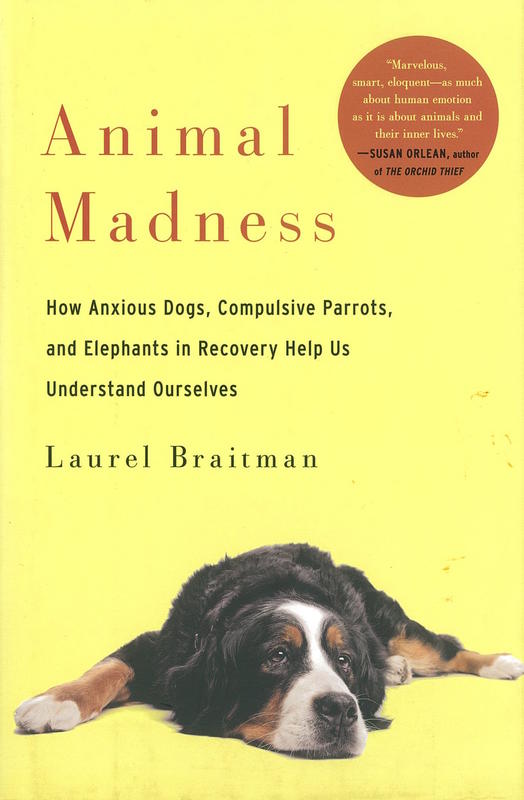
Reference
Animal madness : how anxious dogs, compulsive parrots, and elephants in recovery help us understand ourselves spine
Animal madness : how anxious dogs, compulsive parrots, and elephants in recovery help us understand ourselves cover
Live
No live
No live
Animal madness : how anxious dogs, compulsive parrots, and elephants in recovery help us understand ourselves spine
No live
Animal madness : how anxious dogs, compulsive parrots, and elephants in recovery help us understand ourselves cover
No live
TAGS
Curated Derived
Animals Emotion Geography Life Sciences Madness Psychology Science Social Sciences The Mind
CONNECTIONS
No connections
State
on_shelf
True
position_updated_at
never
orientation
unknown
Details

Physical

binding_type
Hard Back
dimensions
none captured
spine_text
none captured

Metadata

Book form
LOCATION HISTORY
No location history available for this book.
Vernon snapshot
View live

Frozen copy of Vernon's record from the last sync. Fields tagged flow back into the Pulse record.

Last synced 2026-06-04 16:40 (5 days, 20 hours ago)

Identity

name→ title
Animal madness : how anxious dogs, compulsive parrots, and elephants in recovery help us understand ourselves
vernon_id
16170
accession_no→ accession_number
12046
vernon_slug
animal-madness-how-anxious-dogs-compulsive-parrots-and-elephants-in-recovery-help-us-understand-ourselves-laurel-braitman

Drives Pulse state

curr_loc_status→ on_shelf
On Shelf
location_name
Zone N3/Level 2 (Mezzanine)/Phrontisterion/MONA
location_reason
On Shelf
isbn_issn→ isbn (when valid)
9781451627008

Descriptive

production_date
2014
object_type
Books/Document genres/Information forms/Visual and Verbal Communication
object_status
Accessioned
brief_description
For the first time, a historian of science draws evidence from across the world to show how humans and other animals are astonishingly similar when it comes to their feelings and the ways in which they lose their minds. Charles Darwin developed his evolutionary theories by looking at physical differences in Galapagos finches and fancy pigeons. Alfred Russell Wallace investigated a range of creatures in the Malay Archipelago. Laurel Braitman got her lessons closer to home--by watching her dog. Oliver snapped at flies that only he could see, ate Ziploc bags, towels, and cartons of eggs. He suffered debilitating separation anxiety, was prone to aggression, and may even have attempted suicide. Her experience with Oliver forced Laurel to acknowledge a form of continuity between humans and other animals that, first as a biology major and later as a PhD student at MIT, she'd never been taught in school. Nonhuman animals can lose their minds. And when they do, it often looks a lot like human mental illness. Thankfully, all of us can heal. As Laurel spent three years traveling the world in search of emotionally disturbed animals and the people who care for them, she discovered numerous stories of recovery: parrots that learn how to stop plucking their feathers, dogs that cease licking their tails raw, polar bears that stop swimming in compulsive circles, and great apes that benefit from the help of human psychiatrists. How do these animals recover? The same way we do: with love, with medicine, and above all, with the knowledge that someone understands why we suffer and what can make us feel better. After all of the digging in the archives of museums and zoos, the years synthesizing scientific literature, and the hours observing dog parks, wildlife encounters, and amusement parks, Laurel found that understanding the emotional distress of animals can help us better understand ourselves.

Subjects & people

authors→ author (initial fill only)
Laurel Braitman
tags→ tags
Science, Psychology, Life sciences, Nature, Evolution (Biology), Biology, Animals, Domestic animals, Dogs, Evolutionary psychology, Animal behaviour -- Evolution, Behaviour evolution, Animal behaviour, Animal psychology, Animal intelligence, Emotions in animals, Consciousness in animals
subject_people
subject_objects

Cover image

vernon_cover_image_id→ cover_image
18832

Raw Vernon JSON

click to inspect

The source payload behind the snapshot above.

Use ⌘F to search once expanded.
{7 keys}
"slug": "animal-madness-how-anxious-dogs-compulsive-parrots-and-elephants-in-recovery-help-us-understand-ourselves-laurel-braitman"
"opacObjectId": "16170"
"opacCollection": {1 keys}
"opacCollectionId": "1"
"imagesCollection": {2 keys}
"images": [1 items]
"[0]": {5 keys}
"imageId": "18832"
"cssColors": [3 items]
"[0]": {9 keys}
"hex": "f0e68c"
"hue": 54
"rank": 1
"presence": 79.26
"colorName": "khaki"
"lightness": 75
"colorGroup": "yellow"
"saturation": 77
"formattedColorName": "khaki"
"[1]": {9 keys}
"hex": "a0522d"
"hue": 19
"rank": 2
"presence": 9.01
"colorName": "sienna"
"lightness": 40
"colorGroup": "brown"
"saturation": 56
"formattedColorName": "sienna"
"[2]": {9 keys}
"hex": "d2b48c"
"hue": 34
"rank": 3
"presence": 3.22
"colorName": "tan"
"lightness": 69
"colorGroup": "brown"
"saturation": 44
"formattedColorName": "tan"
"rawColors": [7 items]
"[0]": {6 keys}
"hex": "faf988"
"hue": 59
"rank": 1
"presence": 79.26
"lightness": 75
"saturation": 91
"[1]": {6 keys}
"hex": "7d5e4f"
"hue": 19
"rank": 2
"presence": 9.01
"lightness": 40
"saturation": 22
"[2]": {6 keys}
"hex": "695132"
"hue": 33
"rank": 3
"presence": 6.56
"lightness": 30
"saturation": 35
"[3]": {6 keys}
"hex": "bc9a6b"
"hue": 34
"rank": 4
"presence": 3.22
"lightness": 57
"saturation": 37
"[4]": {6 keys}
"hex": "e0d5b6"
"hue": 44
"rank": 5
"presence": 1.27
"lightness": 79
"saturation": 40
"[5]": {6 keys}
"hex": "ece5de"
"hue": 30
"rank": 6
"presence": 0.63
"lightness": 89
"saturation": 26
"[6]": {6 keys}
"hex": "83855e"
"hue": 63
"rank": 7
"presence": 0.05
"lightness": 44
"saturation": 17
"imageLabels": [10 items]
"[0]": {5 keys}
"count": 63
"score": 95.25
"status": "auto_verified"
"imageLabel": "Dog"
"imageLabelId": 782
"[1]": {5 keys}
"count": 31
"score": 89.96
"status": "auto_verified"
"imageLabel": "Dog breed"
"imageLabelId": 783
"[2]": {5 keys}
"count": 99
"score": 87.82
"status": "auto_verified"
"imageLabel": "Carnivore"
"imageLabelId": 243
"[3]": {5 keys}
"count": 12
"score": 82.66
"status": "auto_verified"
"imageLabel": "Companion dog"
"imageLabelId": 876
"[4]": {5 keys}
"count": 11804
"score": 79.44
"status": "auto_verified"
"imageLabel": "Poster"
"imageLabelId": 21
"[5]": {5 keys}
"count": 19418
"score": 79.12
"status": "auto_verified"
"imageLabel": "Font"
"imageLabelId": 12
"[6]": {5 keys}
"count": 192
"score": 74.7
"status": "auto_verified"
"imageLabel": "Snout"
"imageLabelId": 530
"[7]": {5 keys}
"count": 7
"score": 70.26
"status": "auto_verified"
"imageLabel": "Sporting Group"
"imageLabelId": 784
"[8]": {5 keys}
"count": 19109
"score": 69.3
"status": "auto_verified"
"imageLabel": "Publication"
"imageLabelId": 23
"[9]": {5 keys}
"count": 499
"score": 69.17
"status": "auto_verified"
"imageLabel": "Working animal"
"imageLabelId": 247
"imageDerivatives": [6 items]
"[0]": {4 keys}
"url": "https://browser.mona.net.au/records/images/large/4952/347802a761b28049c81c5a5ae6ec67f94d2b6005.jpg"
"width": "524"
"height": "800"
"identifier": "LARGE"
"[1]": {4 keys}
"url": "https://browser.mona.net.au/records/images/medium/4952/347802a761b28049c81c5a5ae6ec67f94d2b6005.jpg"
"width": "262"
"height": "400"
"identifier": "MEDIUM"
"[2]": {4 keys}
"url": "https://browser.mona.net.au/records/images/nano/4952/347802a761b28049c81c5a5ae6ec67f94d2b6005.jpg"
"width": "23"
"height": "35"
"identifier": "NANO"
"[3]": {4 keys}
"url": "https://browser.mona.net.au/records/images/small/4952/347802a761b28049c81c5a5ae6ec67f94d2b6005.jpg"
"width": "98"
"height": "150"
"identifier": "SMALL"
"[4]": {4 keys}
"url": "https://browser.mona.net.au/records/images/tiny/4952/347802a761b28049c81c5a5ae6ec67f94d2b6005.jpg"
"width": "49"
"height": "75"
"identifier": "TINY"
"[5]": {4 keys}
"url": "https://browser.mona.net.au/records/images/xlarge/4952/347802a761b28049c81c5a5ae6ec67f94d2b6005.jpg"
"width": "785"
"height": "1200"
"identifier": "XLARGE"
"totalImages": 1
"objectSearchScore": 1.3075995
"opacObjectFieldSets": [40 items]
"[0]": {2 keys}
"identifier": "accession_no"
"opacObjectFields": [1 items]
"[0]": {1 keys}
"value": "12046"
"[1]": {2 keys}
"identifier": "name"
"opacObjectFields": [1 items]
"[0]": {2 keys}
"value": "Animal madness : how anxious dogs, compulsive parrots, and elephants in recovery help us understand ourselves / Laurel Braitman"
"opacObjectFieldAttributes": [1 items]
"[0]": {2 keys}
"key": "title"
"value": "Animal madness : how anxious dogs, compulsive parrots, and elephants in recovery help us understand ourselves / Laurel Braitman"
"[2]": {2 keys}
"identifier": "other_name"
"opacObjectFields": [1 items]
"[0]": {1 keys}
"value": ""
"[3]": {2 keys}
"identifier": "artist_last_first"
"opacObjectFields": [1 items]
"[0]": {1 keys}
"value": "Braitman, Laurel"
"[4]": {2 keys}
"identifier": "prod_pri_date"
"opacObjectFields": [1 items]
"[0]": {2 keys}
"value": "2014"
"opacObjectFieldAttributes": [2 items]
"[0]": {2 keys}
"key": "earliest_date"
"value": "2014-01-01Z"
"[1]": {2 keys}
"key": "latest_date"
"value": "2014-12-31Z"
"[5]": {2 keys}
"identifier": "prod_pri_date_notes"
"opacObjectFields": [1 items]
"[0]": {1 keys}
"value": ""
"[6]": {2 keys}
"identifier": "edition"
"opacObjectFields": [1 items]
"[0]": {1 keys}
"value": "First Simon &​ Schuster hardcover edition."
"[7]": {2 keys}
"identifier": "brief_desc"
"opacObjectFields": [1 items]
"[0]": {1 keys}
"value": "For the first time, a historian of science draws evidence from across the world to show how humans and other animals are astonishingly similar when it comes to their feelings and the ways in which they lose their minds. Charles Darwin developed his evolutionary theories by looking at physical differences in Galapagos finches and fancy pigeons. Alfred Russell Wallace investigated a range of creatures in the Malay Archipelago. Laurel Braitman got her lessons closer to home--by watching her dog. Oliver snapped at flies that only he could see, ate Ziploc bags, towels, and cartons of eggs. He suffered debilitating separation anxiety, was prone to aggression, and may even have attempted suicide. Her experience with Oliver forced Laurel to acknowledge a form of continuity between humans and other animals that, first as a biology major and later as a PhD student at MIT, she'd never been taught in school. Nonhuman animals can lose their minds. And when they do, it often looks a lot like human mental illness. Thankfully, all of us can heal. As Laurel spent three years traveling the world in search of emotionally disturbed animals and the people who care for them, she discovered numerous stories of recovery: parrots that learn how to stop plucking their feathers, dogs that cease licking their tails raw, polar bears that stop swimming in compulsive circles, and great apes that benefit from the help of human psychiatrists. How do these animals recover? The same way we do: with love, with medicine, and above all, with the knowledge that someone understands why we suffer and what can make us feel better. After all of the digging in the archives of museums and zoos, the years synthesizing scientific literature, and the hours observing dog parks, wildlife encounters, and amusement parks, Laurel found that understanding the emotional distress of animals can help us better understand ourselves."
"[8]": {2 keys}
"identifier": "measure_desc"
"opacObjectFields": [1 items]
"[0]": {1 keys}
"value": ""
"[9]": {2 keys}
"identifier": "credit_line"
"opacObjectFields": [1 items]
"[0]": {1 keys}
"value": ""
"[10]": {2 keys}
"identifier": "curr_loc_status"
"opacObjectFields": [1 items]
"[0]": {2 keys}
"value": "On Shelf"
"opacObjectFieldAttributes": [1 items]
"[0]": {2 keys}
"key": "search"
"value": "curr_loc_status:"On Shelf""
"[11]": {2 keys}
"identifier": "ob_status"
"opacObjectFields": [1 items]
"[0]": {1 keys}
"value": "Accessioned"
"[12]": {2 keys}
"identifier": "lender"
"opacObjectFields": [1 items]
"[0]": {1 keys}
"value": ""
"[13]": {2 keys}
"identifier": "copyright_owner"
"opacObjectFields": [1 items]
"[0]": {1 keys}
"value": ""
"[14]": {2 keys}
"identifier": "copyright_type"
"opacObjectFields": [1 items]
"[0]": {1 keys}
"value": ""
"[15]": {2 keys}
"identifier": "copyright_start"
"opacObjectFields": [0 items]
"[16]": {2 keys}
"identifier": "copyright_expiry"
"opacObjectFields": [0 items]
"[17]": {2 keys}
"identifier": "copyright_notes"
"opacObjectFields": [1 items]
"[0]": {1 keys}
"value": ""
"[18]": {2 keys}
"identifier": "curr_loc"
"opacObjectFields": [1 items]
"[0]": {1 keys}
"value": "Zone N3/Level 2 (Mezzanine)/Phrontisterion/MONA"
"[19]": {2 keys}
"identifier": "object_type"
"opacObjectFields": [1 items]
"[0]": {2 keys}
"value": "Books/Document genres/Information forms/Visual and Verbal Communication"
"opacObjectFieldAttributes": [1 items]
"[0]": {2 keys}
"key": "search"
"value": "object_type:"Books/Document genres/Information forms/Visual and Verbal Communication""
"[20]": {2 keys}
"identifier": "collection"
"opacObjectFields": [1 items]
"[0]": {2 keys}
"value": "Main Collection/Library"
"opacObjectFieldAttributes": [1 items]
"[0]": {2 keys}
"key": "search"
"value": "collection:"Main Collection/Library""
"[21]": {2 keys}
"identifier": "prod_pri_place"
"opacObjectFields": [1 items]
"[0]": {1 keys}
"value": "New York/United States of America"
"[22]": {2 keys}
"identifier": "prod_pri_publisher"
"opacObjectFields": [1 items]
"[0]": {1 keys}
"value": "Simon & Schuster"
"[23]": {2 keys}
"identifier": "physical_notes"
"opacObjectFields": [2 items]
"[0]": {1 keys}
"value": "373 pages : illustrations ; 24 cm."
"[1]": {1 keys}
"value": "Includes bibliographical references (pages 289-360) and index."
"[24]": {2 keys}
"identifier": "language"
"opacObjectFields": [1 items]
"[0]": {1 keys}
"value": "English"
"[25]": {2 keys}
"identifier": "isbn_issn"
"opacObjectFields": [1 items]
"[0]": {1 keys}
"value": "9781451627008"
"[26]": {2 keys}
"identifier": "user_sym_1"
"opacObjectFields": [1 items]
"[0]": {1 keys}
"value": "591.5 BRA"
"[27]": {2 keys}
"identifier": "usual_loc_being"
"opacObjectFields": [1 items]
"[0]": {1 keys}
"value": "Zone N3/Level 2 (Mezzanine)/Phrontisterion/MONA"
"[28]": {2 keys}
"identifier": "subject_class"
"opacObjectFields": [10 items]
"[0]": {2 keys}
"value": "Nature"
"opacObjectFieldAttributes": [1 items]
"[0]": {2 keys}
"key": "search"
"value": "subject_class:"Nature""
"[1]": {2 keys}
"value": "Animal behaviour/Animal psychology/Psychology"
"opacObjectFieldAttributes": [1 items]
"[0]": {2 keys}
"key": "search"
"value": "subject_class:"Animal behaviour/Animal psychology/Psychology""
"[2]": {2 keys}
"value": "Emotions in animals/Animal psychology/Psychology"
"opacObjectFieldAttributes": [1 items]
"[0]": {2 keys}
"key": "search"
"value": "subject_class:"Emotions in animals/Animal psychology/Psychology""
"[3]": {2 keys}
"value": "Consciousness in animals/Animal psychology/Psychology"
"opacObjectFieldAttributes": [1 items]
"[0]": {2 keys}
"key": "search"
"value": "subject_class:"Consciousness in animals/Animal psychology/Psychology""
"[4]": {2 keys}
"value": "Animal intelligence/Animal psychology/Psychology"
"opacObjectFieldAttributes": [1 items]
"[0]": {2 keys}
"key": "search"
"value": "subject_class:"Animal intelligence/Animal psychology/Psychology""
"[5]": {2 keys}
"value": "Animals"
"opacObjectFieldAttributes": [1 items]
"[0]": {2 keys}
"key": "search"
"value": "subject_class:"Animals""
"[6]": {2 keys}
"value": "Psychology"
"opacObjectFieldAttributes": [1 items]
"[0]": {2 keys}
"key": "search"
"value": "subject_class:"Psychology""
"[7]": {2 keys}
"value": "Evolution (Biology)/Biology/Life sciences/Science"
"opacObjectFieldAttributes": [1 items]
"[0]": {2 keys}
"key": "search"
"value": "subject_class:"Evolution (Biology)/Biology/Life sciences/Science""
"[8]": {2 keys}
"value": "Animal behaviour -- Evolution/Behaviour evolution/Evolutionary psychology/Psychology"
"opacObjectFieldAttributes": [1 items]
"[0]": {2 keys}
"key": "search"
"value": "subject_class:"Animal behaviour -- Evolution/Behaviour evolution/Evolutionary psychology/Psychology""
"[9]": {2 keys}
"value": "Dogs/Domestic animals/Animals"
"opacObjectFieldAttributes": [1 items]
"[0]": {2 keys}
"key": "search"
"value": "subject_class:"Dogs/Domestic animals/Animals""
"[29]": {2 keys}
"identifier": "subject_date"
"opacObjectFields": [0 items]
"[30]": {2 keys}
"identifier": "subject_event"
"opacObjectFields": [1 items]
"[0]": {1 keys}
"value": ""
"[31]": {2 keys}
"identifier": "subject_period"
"opacObjectFields": [1 items]
"[0]": {1 keys}
"value": ""
"[32]": {2 keys}
"identifier": "subject_object"
"opacObjectFields": [1 items]
"[0]": {1 keys}
"value": ""
"[33]": {2 keys}
"identifier": "subject_person"
"opacObjectFields": [1 items]
"[0]": {1 keys}
"value": ""
"[34]": {2 keys}
"identifier": "subject_place"
"opacObjectFields": [1 items]
"[0]": {1 keys}
"value": ""
"[35]": {2 keys}
"identifier": "assoc_person"
"opacObjectFields": [1 items]
"[0]": {1 keys}
"value": ""
"[36]": {2 keys}
"identifier": "assoc_place"
"opacObjectFields": [1 items]
"[0]": {1 keys}
"value": ""
"[37]": {2 keys}
"identifier": "assoc_event"
"opacObjectFields": [1 items]
"[0]": {1 keys}
"value": ""
"[38]": {2 keys}
"identifier": "assoc_object"
"opacObjectFields": [1 items]
"[0]": {1 keys}
"value": ""
"[39]": {2 keys}
"identifier": "user_sym_9"
"opacObjectFields": [1 items]
"[0]": {1 keys}
"value": ""
"relationshipsCollection": {2 keys}
"relationships": [1 items]
"[0]": {4 keys}
"relatedRecords": [1 items]
"[0]": {3 keys}
"slug": "laurel-braitman"
"title": "Laurel Braitman"
"relatedRecordId": "24325"
"relationshipId": "object_prod_pri_person"
"relatedRecordType": "person"
"totalRelatedRecords": 1
"totalRelationships": 1
Topics and Themes