M:S3:22 3
Edit position
Edit position

Last set 6 days, 1 hour ago. Manual moves override automatic placement until the next shelfie/spine match.

How language began : the story of humanity's greatest invention / Daniel L. Everett
Diagnose this book
Open in Vernon Browser

How language began : the story of humanity's greatest invention / Daniel L. Everett

by Daniel Leonard Everett

This interdisciplinary study explores the origins of human speech, proposing that language is a cultural tool rather than an innate biological instinct. It traces the development of communication from early hominids to the thousands of languages spoken today.

Accession 11912 ISBN 9780871407955 Publisher Liveright Publishing
Book Images
Reference and live side by side Hover to see live images

Reference
How language began : the story of humanity's greatest invention / Daniel L. Everett spine
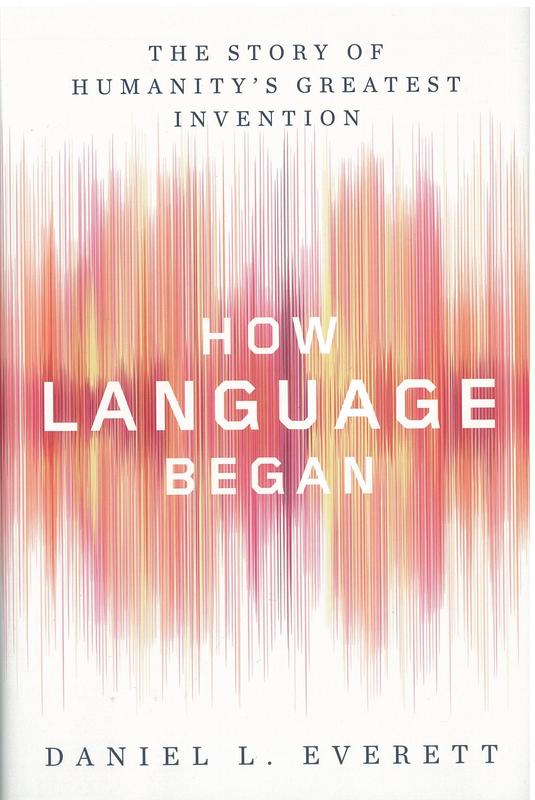
How language began : the story of humanity's greatest invention / Daniel L. Everett cover
Live
How language began : the story of humanity's greatest invention / Daniel L. Everett live spine
No live
How language began : the story of humanity's greatest invention / Daniel L. Everett spine How language began : the story of humanity's greatest invention / Daniel L. Everett live spine
How language began : the story of humanity's greatest invention / Daniel L. Everett cover
No live
TAGS
Curated Derived
Communication Culture Human Evolution Life Sciences Linguistics Science Social Sciences
CONNECTIONS
No connections
State
on_shelf
True
position_updated_at
2026-06-04 14:47
orientation
vertical
Details

Physical

binding_type
Hard Back
dimensions
none captured
spine_text
none captured

Metadata

Book form
LOCATION HISTORY
M:S3:22 3 Current vertical
6 days, 1 hour ago
3 weeks, 5 days ago
Book Location
Updated 6 days, 1 hour ago
Vernon snapshot
View live

Frozen copy of Vernon's record from the last sync. Fields tagged flow back into the Pulse record.

Last synced 2026-05-21 00:55 (2 weeks, 6 days ago)

Identity

name→ title
How language began : the story of humanity's greatest invention / Daniel L. Everett
vernon_id
15988
accession_no→ accession_number
11912
vernon_slug
how-language-began-the-story-of-humanitys-greatest-invention-daniel-l-everett

Drives Pulse state

curr_loc_status→ on_shelf
On Shelf
location_name
Zone S3/Level 2 (Mezzanine)/Phrontisterion/MONA
location_reason
On Shelf
isbn_issn→ isbn (when valid)
9780871407955

Descriptive

production_date
2017
object_type
Books/Document genres/Information forms/Visual and Verbal Communication
object_status
Accessioned
brief_description
Daniel L. Everett, a bombshell linguist and instant folk hero (Tom Wolfe, Harper s), provides in this sweeping history a comprehensive examination of the evolutionary story of language, from the earliest speaking attempts by hominids to the more than seven thousand languages that exist today. Although fossil hunters and linguists have brought us closer to unearthing the true origins of language, Daniel Everett s discoveries have upended the contemporary linguistic world, reverberating far beyond academic circles. While conducting field research in the Amazonian rainforest, Everett came across an age-old language nestled amongst a tribe of hunter-gatherers. Challenging long-standing principles in the field, Everett now builds on the theory that language was not intrinsic to our species. In order to truly understand its origins, a more interdisciplinary approach is needed-one that accounts as much for our propensity for culture as it does our biological makeup. Language began, Everett theorizes, with Homo Erectus, who catalyzed words through culturally invented symbols. Early humans, as their brains grew larger, incorporated gestures and voice intonations to communicate, all of which built on each other for 60,000 generations. Tracing crucial shifts and developments across the ages, Everett breaks down every component of speech, from harnessing control of more than a hundred respiratory muscles in the larynx and diaphragm, to mastering the use of the tongue. Moving on from biology to execution, Everett explores why elements such as grammar and storytelling are not nearly as critical to language as one might suspect. In the book s final section, Cultural Evolution of Language, Everett takes the ever-debated language gap to task, delving into the chasm that separates us from the animals. He approaches the subject from various disciplines, including anthropology, neuroscience, and archaeology, to reveal that it was social complexity, as well as cultural, physiological, and neurological superiority, that allowed humans-with our clawless hands, breakable bones, and soft skin-to become the apex predator. How Language Began ultimately explains what we know, what we d like to know, and what we likely never will know about how humans went from mere communication to language. Based on nearly forty years of fieldwork, Everett debunks long-held theories by some of history s greatest thinkers, from Plato to Chomsky. The result is an invaluable study of what makes us human.

Subjects & people

authors→ author (initial fill only)
Daniel Leonard Everett
tags→ tags
Science, Life sciences, Social sciences, Civilisation, Sociology, Language and languages, Communication, Linguistics, Anthropology, Evolution (Biology), Biology, Human evolution, Language and languages -- Origin
subject_people
subject_objects

Cover image

vernon_cover_image_id→ cover_image
21490

Raw Vernon JSON

click to inspect

The source payload behind the snapshot above.

Use ⌘F to search once expanded.
{7 keys}
"slug": "how-language-began-the-story-of-humanitys-greatest-invention-daniel-l-everett"
"opacObjectId": "15988"
"opacCollection": {1 keys}
"opacCollectionId": "1"
"imagesCollection": {2 keys}
"images": [1 items]
"[0]": {5 keys}
"imageId": "21490"
"cssColors": [3 items]
"[0]": {9 keys}
"hex": "faf0e6"
"hue": 30
"rank": 1
"presence": 63.99
"colorName": "linen"
"lightness": 94
"colorGroup": "white"
"saturation": 67
"formattedColorName": "linen"
"[1]": {9 keys}
"hex": "cd5c5c"
"hue": 0
"rank": 2
"presence": 6.32
"colorName": "chestnut"
"lightness": 58
"colorGroup": "red"
"saturation": 53
"formattedColorName": "chestnut"
"[2]": {9 keys}
"hex": "e9967a"
"hue": 15
"rank": 3
"presence": 10.08
"colorName": "darksalmon"
"lightness": 70
"colorGroup": "red"
"saturation": 72
"formattedColorName": "dark salmon"
"rawColors": [7 items]
"[0]": {6 keys}
"hex": "f6efeb"
"hue": 21
"rank": 1
"presence": 63.99
"lightness": 94
"saturation": 37
"[1]": {6 keys}
"hex": "d06e71"
"hue": 358
"rank": 2
"presence": 6.32
"lightness": 62
"saturation": 51
"[2]": {6 keys}
"hex": "e19d95"
"hue": 6
"rank": 3
"presence": 15.8
"lightness": 73
"saturation": 55
"[3]": {6 keys}
"hex": "ebbda4"
"hue": 21
"rank": 4
"presence": 10.08
"lightness": 78
"saturation": 63
"[4]": {6 keys}
"hex": "de8e77"
"hue": 13
"rank": 5
"presence": 3.06
"lightness": 66
"saturation": 60
"[5]": {6 keys}
"hex": "666769"
"hue": 220
"rank": 6
"presence": 0.57
"lightness": 40
"saturation": 1
"[6]": {6 keys}
"hex": "b9bbbd"
"hue": 210
"rank": 7
"presence": 0.19
"lightness": 73
"saturation": 2
"imageLabels": [10 items]
"[0]": {5 keys}
"count": 141
"score": 98.52
"status": "auto_verified"
"imageLabel": "Hair"
"imageLabelId": 55
"[1]": {5 keys}
"count": 2122
"score": 86.28
"status": "auto_verified"
"imageLabel": "Organism"
"imageLabelId": 33
"[2]": {5 keys}
"count": 19411
"score": 82.34
"status": "auto_verified"
"imageLabel": "Font"
"imageLabelId": 12
"[3]": {5 keys}
"count": 2193
"score": 79.05
"status": "auto_verified"
"imageLabel": "Magenta"
"imageLabelId": 30
"[4]": {5 keys}
"count": 509
"score": 75.95
"status": "auto_verified"
"imageLabel": "Eyelash"
"imageLabelId": 59
"[5]": {5 keys}
"count": 10019
"score": 75.53
"status": "auto_verified"
"imageLabel": "Rectangle"
"imageLabelId": 11
"[6]": {5 keys}
"count": 5578
"score": 75.31
"status": "auto_verified"
"imageLabel": "Pattern"
"imageLabelId": 24
"[7]": {5 keys}
"count": 19018
"score": 74.83
"status": "auto_verified"
"imageLabel": "Publication"
"imageLabelId": 23
"[8]": {5 keys}
"count": 3188
"score": 74.31
"status": "auto_verified"
"imageLabel": "Wood"
"imageLabelId": 3
"[9]": {5 keys}
"count": 487
"score": 72.13
"status": "auto_verified"
"imageLabel": "Peach"
"imageLabelId": 31
"imageDerivatives": [6 items]
"[0]": {4 keys}
"url": "https://browser.mona.net.au/records/images/large/4751/daf1b73900d9f25b246e53d45b46176f8f6342c9.jpg"
"width": "535"
"height": "800"
"identifier": "LARGE"
"[1]": {4 keys}
"url": "https://browser.mona.net.au/records/images/medium/4751/daf1b73900d9f25b246e53d45b46176f8f6342c9.jpg"
"width": "268"
"height": "400"
"identifier": "MEDIUM"
"[2]": {4 keys}
"url": "https://browser.mona.net.au/records/images/nano/4751/daf1b73900d9f25b246e53d45b46176f8f6342c9.jpg"
"width": "23"
"height": "35"
"identifier": "NANO"
"[3]": {4 keys}
"url": "https://browser.mona.net.au/records/images/small/4751/daf1b73900d9f25b246e53d45b46176f8f6342c9.jpg"
"width": "100"
"height": "150"
"identifier": "SMALL"
"[4]": {4 keys}
"url": "https://browser.mona.net.au/records/images/tiny/4751/daf1b73900d9f25b246e53d45b46176f8f6342c9.jpg"
"width": "50"
"height": "75"
"identifier": "TINY"
"[5]": {4 keys}
"url": "https://browser.mona.net.au/records/images/xlarge/4751/daf1b73900d9f25b246e53d45b46176f8f6342c9.jpg"
"width": "803"
"height": "1200"
"identifier": "XLARGE"
"totalImages": 1
"objectSearchScore": 0.31199765
"opacObjectFieldSets": [40 items]
"[0]": {2 keys}
"identifier": "accession_no"
"opacObjectFields": [1 items]
"[0]": {1 keys}
"value": "11912"
"[1]": {2 keys}
"identifier": "name"
"opacObjectFields": [1 items]
"[0]": {2 keys}
"value": "How language began : the story of humanity's greatest invention / Daniel L. Everett"
"opacObjectFieldAttributes": [1 items]
"[0]": {2 keys}
"key": "title"
"value": "How language began : the story of humanity's greatest invention / Daniel L. Everett"
"[2]": {2 keys}
"identifier": "other_name"
"opacObjectFields": [1 items]
"[0]": {1 keys}
"value": ""
"[3]": {2 keys}
"identifier": "artist_last_first"
"opacObjectFields": [1 items]
"[0]": {1 keys}
"value": "Everett, Daniel Leonard"
"[4]": {2 keys}
"identifier": "prod_pri_date"
"opacObjectFields": [1 items]
"[0]": {2 keys}
"value": "2017"
"opacObjectFieldAttributes": [2 items]
"[0]": {2 keys}
"key": "earliest_date"
"value": "2017-01-01Z"
"[1]": {2 keys}
"key": "latest_date"
"value": "2017-12-31Z"
"[5]": {2 keys}
"identifier": "prod_pri_date_notes"
"opacObjectFields": [1 items]
"[0]": {1 keys}
"value": ""
"[6]": {2 keys}
"identifier": "edition"
"opacObjectFields": [1 items]
"[0]": {1 keys}
"value": "First American Edition 2017"
"[7]": {2 keys}
"identifier": "brief_desc"
"opacObjectFields": [1 items]
"[0]": {1 keys}
"value": "Daniel L. Everett, a bombshell linguist and instant folk hero (Tom Wolfe, Harper s), provides in this sweeping history a comprehensive examination of the evolutionary story of language, from the earliest speaking attempts by hominids to the more than seven thousand languages that exist today. Although fossil hunters and linguists have brought us closer to unearthing the true origins of language, Daniel Everett s discoveries have upended the contemporary linguistic world, reverberating far beyond academic circles. While conducting field research in the Amazonian rainforest, Everett came across an age-old language nestled amongst a tribe of hunter-gatherers. Challenging long-standing principles in the field, Everett now builds on the theory that language was not intrinsic to our species. In order to truly understand its origins, a more interdisciplinary approach is needed-one that accounts as much for our propensity for culture as it does our biological makeup. Language began, Everett theorizes, with Homo Erectus, who catalyzed words through culturally invented symbols. Early humans, as their brains grew larger, incorporated gestures and voice intonations to communicate, all of which built on each other for 60,000 generations. Tracing crucial shifts and developments across the ages, Everett breaks down every component of speech, from harnessing control of more than a hundred respiratory muscles in the larynx and diaphragm, to mastering the use of the tongue. Moving on from biology to execution, Everett explores why elements such as grammar and storytelling are not nearly as critical to language as one might suspect. In the book s final section, Cultural Evolution of Language, Everett takes the ever-debated language gap to task, delving into the chasm that separates us from the animals. He approaches the subject from various disciplines, including anthropology, neuroscience, and archaeology, to reveal that it was social complexity, as well as cultural, physiological, and neurological superiority, that allowed humans-with our clawless hands, breakable bones, and soft skin-to become the apex predator. How Language Began ultimately explains what we know, what we d like to know, and what we likely never will know about how humans went from mere communication to language. Based on nearly forty years of fieldwork, Everett debunks long-held theories by some of history s greatest thinkers, from Plato to Chomsky. The result is an invaluable study of what makes us human."
"[8]": {2 keys}
"identifier": "measure_desc"
"opacObjectFields": [1 items]
"[0]": {1 keys}
"value": ""
"[9]": {2 keys}
"identifier": "credit_line"
"opacObjectFields": [1 items]
"[0]": {1 keys}
"value": ""
"[10]": {2 keys}
"identifier": "curr_loc_status"
"opacObjectFields": [1 items]
"[0]": {2 keys}
"value": "On Shelf"
"opacObjectFieldAttributes": [1 items]
"[0]": {2 keys}
"key": "search"
"value": "curr_loc_status:"On Shelf""
"[11]": {2 keys}
"identifier": "ob_status"
"opacObjectFields": [1 items]
"[0]": {1 keys}
"value": "Accessioned"
"[12]": {2 keys}
"identifier": "lender"
"opacObjectFields": [1 items]
"[0]": {1 keys}
"value": ""
"[13]": {2 keys}
"identifier": "copyright_owner"
"opacObjectFields": [1 items]
"[0]": {1 keys}
"value": ""
"[14]": {2 keys}
"identifier": "copyright_type"
"opacObjectFields": [1 items]
"[0]": {1 keys}
"value": ""
"[15]": {2 keys}
"identifier": "copyright_start"
"opacObjectFields": [0 items]
"[16]": {2 keys}
"identifier": "copyright_expiry"
"opacObjectFields": [0 items]
"[17]": {2 keys}
"identifier": "copyright_notes"
"opacObjectFields": [1 items]
"[0]": {1 keys}
"value": ""
"[18]": {2 keys}
"identifier": "curr_loc"
"opacObjectFields": [1 items]
"[0]": {1 keys}
"value": "Zone S3/Level 2 (Mezzanine)/Phrontisterion/MONA"
"[19]": {2 keys}
"identifier": "object_type"
"opacObjectFields": [1 items]
"[0]": {2 keys}
"value": "Books/Document genres/Information forms/Visual and Verbal Communication"
"opacObjectFieldAttributes": [1 items]
"[0]": {2 keys}
"key": "search"
"value": "object_type:"Books/Document genres/Information forms/Visual and Verbal Communication""
"[20]": {2 keys}
"identifier": "collection"
"opacObjectFields": [1 items]
"[0]": {2 keys}
"value": "Main Collection/Library"
"opacObjectFieldAttributes": [1 items]
"[0]": {2 keys}
"key": "search"
"value": "collection:"Main Collection/Library""
"[21]": {2 keys}
"identifier": "prod_pri_place"
"opacObjectFields": [1 items]
"[0]": {1 keys}
"value": "New York City/New York/United States of America"
"[22]": {2 keys}
"identifier": "prod_pri_publisher"
"opacObjectFields": [1 items]
"[0]": {1 keys}
"value": "Liveright Publishing"
"[23]": {2 keys}
"identifier": "physical_notes"
"opacObjectFields": [2 items]
"[0]": {1 keys}
"value": "xviii, 330 pages : illustrations ; 24 cm."
"[1]": {1 keys}
"value": "Includes bibligraphical references and index."
"[24]": {2 keys}
"identifier": "language"
"opacObjectFields": [1 items]
"[0]": {1 keys}
"value": "English"
"[25]": {2 keys}
"identifier": "isbn_issn"
"opacObjectFields": [1 items]
"[0]": {1 keys}
"value": "9780871407955"
"[26]": {2 keys}
"identifier": "user_sym_1"
"opacObjectFields": [1 items]
"[0]": {1 keys}
"value": "401 EVE"
"[27]": {2 keys}
"identifier": "usual_loc_being"
"opacObjectFields": [1 items]
"[0]": {1 keys}
"value": "Zone S3/Level 2 (Mezzanine)/Phrontisterion/MONA"
"[28]": {2 keys}
"identifier": "subject_class"
"opacObjectFields": [5 items]
"[0]": {2 keys}
"value": "Anthropology"
"opacObjectFieldAttributes": [1 items]
"[0]": {2 keys}
"key": "search"
"value": "subject_class:"Anthropology""
"[1]": {2 keys}
"value": "Human evolution/Evolution (Biology)/Biology/Life sciences/Science"
"opacObjectFieldAttributes": [1 items]
"[0]": {2 keys}
"key": "search"
"value": "subject_class:"Human evolution/Evolution (Biology)/Biology/Life sciences/Science""
"[2]": {2 keys}
"value": "Language and languages/Communication/Sociology/Social sciences/Civilisation"
"opacObjectFieldAttributes": [1 items]
"[0]": {2 keys}
"key": "search"
"value": "subject_class:"Language and languages/Communication/Sociology/Social sciences/Civilisation""
"[3]": {2 keys}
"value": "Linguistics"
"opacObjectFieldAttributes": [1 items]
"[0]": {2 keys}
"key": "search"
"value": "subject_class:"Linguistics""
"[4]": {2 keys}
"value": "Language and languages -- Origin/Communication/Sociology/Social sciences/Civilisation"
"opacObjectFieldAttributes": [1 items]
"[0]": {2 keys}
"key": "search"
"value": "subject_class:"Language and languages -- Origin/Communication/Sociology/Social sciences/Civilisation""
"[29]": {2 keys}
"identifier": "subject_date"
"opacObjectFields": [0 items]
"[30]": {2 keys}
"identifier": "subject_event"
"opacObjectFields": [1 items]
"[0]": {1 keys}
"value": ""
"[31]": {2 keys}
"identifier": "subject_period"
"opacObjectFields": [1 items]
"[0]": {1 keys}
"value": ""
"[32]": {2 keys}
"identifier": "subject_object"
"opacObjectFields": [1 items]
"[0]": {1 keys}
"value": ""
"[33]": {2 keys}
"identifier": "subject_person"
"opacObjectFields": [1 items]
"[0]": {1 keys}
"value": ""
"[34]": {2 keys}
"identifier": "subject_place"
"opacObjectFields": [1 items]
"[0]": {1 keys}
"value": ""
"[35]": {2 keys}
"identifier": "assoc_person"
"opacObjectFields": [1 items]
"[0]": {1 keys}
"value": ""
"[36]": {2 keys}
"identifier": "assoc_place"
"opacObjectFields": [1 items]
"[0]": {1 keys}
"value": ""
"[37]": {2 keys}
"identifier": "assoc_event"
"opacObjectFields": [1 items]
"[0]": {1 keys}
"value": ""
"[38]": {2 keys}
"identifier": "assoc_object"
"opacObjectFields": [1 items]
"[0]": {1 keys}
"value": ""
"[39]": {2 keys}
"identifier": "user_sym_9"
"opacObjectFields": [1 items]
"[0]": {1 keys}
"value": ""
"relationshipsCollection": {2 keys}
"relationships": [1 items]
"[0]": {4 keys}
"relatedRecords": [1 items]
"[0]": {3 keys}
"slug": "daniel-leonard-everett"
"title": "Daniel Leonard Everett"
"relatedRecordId": "24097"
"relationshipId": "object_prod_pri_person"
"relatedRecordType": "person"
"totalRelatedRecords": 1
"totalRelationships": 1
Topics and Themes
