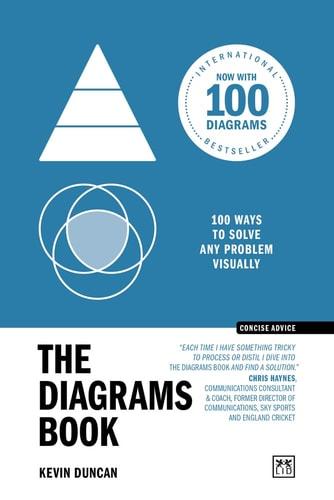
1. **Visual Thinking & Non-Verbal Communication**
The book is built on the premise that people struggle to express ideas using words alone, and that diagrams offer a more intuitive, accessible language. It reframes communication as something that can — and often should — bypass text entirely in favour of visual form.

The central argument is that shapes, spatial relationships, and visual structure carry meaning that words cannot easily replicate.

Connect to books about: visual literacy, graphic facilitation, sketchnoting, non-verbal communication, design thinking.

---

2. **Problem-Solving Frameworks & Mental Models**
The book presents 50 structured visual tools specifically chosen to help people work through problems — covering triangles, pyramids, grids, axes, timelines, flows, and circles. Each diagram is a reusable cognitive template applicable across many contexts.

The underlying idea is that having a library of ready-made frameworks speeds up and sharpens thinking when facing complex or ambiguous situations.

Connect to books about: mental models, systems thinking, decision-making, analytical frameworks, lateral thinking.

---

3. **Business Strategy & Management Thinking**
The diagrams are explicitly drawn from the toolkit of consultants, MBA students, and managers, making the book firmly grounded in business strategy and organisational problem-solving. Many diagrams address topics such as sales, performance, and goal-setting.

The book sits at the intersection of management theory and practical application, offering condensed strategic tools for professionals.

Connect to books about: business strategy, management consulting, MBA frameworks, organisational behaviour, leadership.

---

4. **Data Visualisation & Information Design**
By cataloguing how different visual forms — pyramids, grids, flow diagrams, Venn-style circles — communicate different types of relationships and hierarchies, the book touches on the principles of information design: how structure and layout shape meaning.

It implicitly explores how visual choices (overlap vs. separation, hierarchy vs. equality) influence how an audience interprets information.

Connect to books about: data visualisation, information architecture, Edward Tufte-style design, infographics, cartography.

---

5. **Spatial & Relational Reasoning**
A recurring dimension of the book is how diagrams map relationships — similarity, difference, overlap, proximity, sequence. Each shape encodes a relational logic: is X above or below Y? Does A overlap with B? Are things moving closer together or further apart?

This makes the book a quiet meditation on how humans use space to represent abstract relationships and structures of thought.

Connect to books about: cognitive science, spatial reasoning, semiotics, logic, philosophy of mind.

---

6. **Simplicity, Clarity & the Art of Condensing Complexity**
The book is deliberately short on words, dense with meaning, and designed to be read in a single sitting. It champions the discipline of reduction — distilling complex ideas into their clearest, most communicable form.

This connects to a broader intellectual tradition that values clarity and concision as virtues in thinking and communication.

Connect to books about: minimalism in communication, plain language, editing and writing craft, Occam's razor, the art of explanation.

---

7. **Learning, Teaching & Knowledge Transfer**
The diagrams function as pedagogical tools — ways of explaining ideas to others. The book has been applied to PhD theses, sales training, classroom teaching, and client consultancy, suggesting its diagrams serve as bridges between expert knowledge and lay understanding.

It raises questions about how knowledge is best transmitted: through argument, through narrative, or through visual structure.

Connect to books about: pedagogy, instructional design, adult learning, knowledge management, presentation skills.

---

8. **Creativity & Ideation**
Though rooted in business, the book operates as a creativity prompt — a set of lenses through which to view a problem differently. Each diagram offers a fresh angle, and the act of choosing which framework to apply is itself a creative decision.

The book implicitly argues that having more visual tools expands the range of ideas one can generate and communicate.

Connect to books about: creative thinking, brainstorming methods, innovation, design sprints, lateral and divergent thinking.