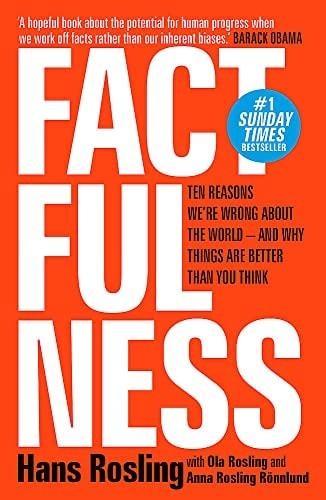
1. **Cognitive Bias & Human Instinct**
   At the heart of *Factfulness* is an exploration of ten deep-seated instincts — such as the gap instinct, the negativity instinct, the fear instinct, and the blame instinct — that systematically distort how we perceive reality. These are not random errors but predictable cognitive patterns rooted in evolutionary psychology, causing even educated and intelligent people to misread the world around them.

   The book's central argument is that our minds are wired for a world that no longer exists, and that understanding *why* we think wrongly is the first step to thinking better.

   Connect to books about: cognitive psychology, behavioural economics, heuristics and biases, evolutionary psychology.

2. **Critical Thinking & Fact-Based Worldviews**
   Rosling champions a disciplined, data-driven way of engaging with the world — what he calls "factfulness" — as an antidote to emotionally-driven, dramatic thinking. He offers practical tools for checking each instinct and building a more accurate mental model of reality.

   The book is as much a manual for better reasoning as it is a portrait of global progress, arguing that intellectual humility and curiosity are prerequisites for sound judgement.

   Connect to books about: critical thinking, rationalism, decision-making, scientific literacy, epistemology.

3. **Global Development & Poverty**
   Rosling dismantles the outdated binary of "developed" versus "developing" nations, replacing it with a four-level income framework that more accurately reflects the dramatic economic progress made across the world. He shows that extreme poverty has fallen sharply and that most of humanity now lives in a differentiated middle ground.

   This reframing challenges readers to update inherited assumptions about the Global South and to see development as a continuum rather than a divide.

   Connect to books about: international development, global economics, poverty reduction, inequality, the Global South.

4. **Media, Misinformation & Public Perception**
   A recurring diagnosis in the book is that mass media systematically skews public understanding by amplifying dramatic, negative, and exceptional events while ignoring slow, positive, incremental change. This creates a perpetually distorted picture of the world in the minds of ordinary people.

   Rosling argues that the news is not a reliable map of reality — it is a map of what is alarming and unusual, which are very different things.

   Connect to books about: media literacy, journalism, propaganda, post-truth politics, information disorder.

5. **Data Visualisation & Statistical Literacy**
   Rosling was a pioneer in making global data vivid and accessible, and the book reflects his belief that numbers — when presented well — can transform how people understand the world. He consistently uses comparisons, ratios, and trends to give statistics meaningful context.

   Underlying the book is a conviction that quantitative literacy is a civic and moral skill, not merely a technical one.

   Connect to books about: data visualisation, statistics, numeracy, science communication, public health metrics.

6. **Global Health & Human Progress**
   Drawing on his career as a physician and global health researcher, Rosling tracks extraordinary improvements in life expectancy, child mortality, vaccination rates, and disease reduction across the world. These are offered as evidence of measurable, real human progress that most people are entirely unaware of.

   The book reframes global health not as a story of perpetual crisis but as one of the great — and underreported — achievements of modern civilisation.

   Connect to books about: global health, epidemiology, public health policy, humanitarian aid, the history of medicine.

7. **Optimism, Progress & the Case Against Pessimism**
   *Factfulness* is a sustained argument that the world, by most objective measures, is getting better — and that pessimism, however culturally fashionable, is empirically unjustified. Rosling distinguishes this from naïve optimism, insisting that a clear-eyed look at the data is itself the source of hope.

   This places the book in a tradition of "rational optimism" that challenges both doomsday narratives and complacency alike.

   Connect to books about: progress studies, secular humanism, rational optimism, the Enlightenment, long-term thinking.

8. **Risk Perception & Decision-Making Under Uncertainty**
   The book devotes significant attention to how poorly humans assess risk — overestimating the danger of vivid, dramatic threats (terrorism, plane crashes) while underestimating mundane but statistically significant ones. This mis