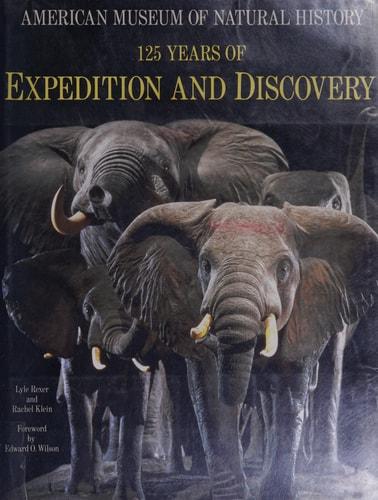
1. **The Age of Scientific Exploration & Expeditions**
The book chronicles a golden age of museum-sponsored expeditions, dispatching scientists and explorers to the poles, the Gobi Desert, the Pacific Northwest, Africa, and beyond in pursuit of specimens and knowledge. These were journeys defined by danger, ambition, and physical hardship — equal parts scientific mission and high adventure.

The book's central premise is that an institution's greatness can be measured by the daring of its expeditions into the unknown.

Connect to books about: history of exploration, polar expeditions, scientific field work, adventure travel.

---

2. **Natural History Museums as Knowledge Institutions**
The museum is portrayed not just as a display space but as an active engine of knowledge production — funding research, building collections, and shaping public understanding of the natural world over more than a century.

The book invites reflection on how institutions curate, legitimize, and transmit scientific knowledge to society.

Connect to books about: museum studies, history of science, public education, institutional history.

---

3. **Archaeology, Anthropology & the Study of Human Origins**
The book covers forays into archaeology and anthropology, including Franz Boas's study of Pacific Northwest indigenous cultures, Margaret Mead's fieldwork, and expeditions in search of the earliest Americans — all efforts to understand humanity's deep past and cultural diversity.

These stories raise enduring questions about how Western science has defined and studied "other" cultures.

Connect to books about: cultural anthropology, archaeology, indigenous studies, history of anthropology.

---

4. **Paleontology & the Discovery of Prehistoric Life**
Dinosaur bone excavations — including the legendary work of Barnum Brown — and expeditions to the Gobi Desert in search of fossils are central to the book's narrative, reflecting the museum's pivotal role in shaping our understanding of prehistoric life.

These expeditions helped transform paleontology from a fringe pursuit into a cornerstone of modern science.

Connect to books about: paleontology, dinosaurs, evolutionary biology, geological history.

---

5. **Colonialism, Collection & the Ethics of Acquisition**
The museum's heyday of collecting in the late 19th and early 20th centuries involved acquiring objects and specimens from cultures around the world — a practice that sits uncomfortably alongside modern standards of provenance and consent, a tension the book largely sidesteps.

The question of who has the right to collect, own, and display the natural and cultural heritage of others runs as an unresolved undercurrent through the institution's history.

Connect to books about: colonial history, museum repatriation, cultural property law, postcolonial theory.

---

6. **Heroic Figures & the Mythology of the Explorer-Scientist**
The book is populated by near-mythic personalities — Robert E. Peary, Roy Chapman Andrews, Carl Akeley, Margaret Mead, Theodore Roosevelt — whose larger-than-life exploits blurred the line between scientist and adventurer, and whose reputations were carefully cultivated by the museum.

The explorer-scientist became a powerful cultural archetype, shaping how the public imagined discovery and progress.

Connect to books about: biography of scientists, history of exploration, celebrity and science, American intellectual history.

---

7. **Visual Documentation & the Role of Photography in Science**
With over 240 photographs — including hand-tinted lantern slides and field images by explorers like Carl Akeley — the book foregrounds how visual media became essential to scientific documentation, public engagement, and institutional storytelling.

Photography here is not mere illustration; it is evidence, propaganda, and art simultaneously.

Connect to books about: history of photography, science communication, documentary photography, visual anthropology.

---

8. **Natural History, Biodiversity & Conservation**
The expeditions that built the museum's collections were fundamentally about cataloguing the natural world — its animals, ecosystems, and geological formations — at a moment when much of that world was still unknown to Western science, and before conservation became a mainstream concern.

The specimens gathered then now serve as irreplaceable scientific baselines for understanding biodiversity loss and environmental change.

Connect to books about: conservation biology, natural history, ecology, environmental history.