1. **Probabilistic Thinking & Uncertainty**
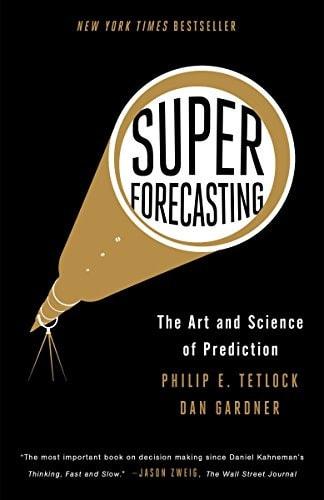
The book's central argument is that the future is not simply unknowable — it can be reasoned about with calibrated probability. Superforecasters think in likelihoods rather than certainties, constantly weighing evidence and adjusting confidence levels rather than making blunt yes/no predictions.

The core skill is learning to hold uncertainty comfortably: to say "there is a 63% chance of X" rather than "X will happen" — and to mean it rigorously.

Connect to books about: probability theory, Bayesian reasoning, risk assessment, statistical thinking.

---

2. **Cognitive Biases & the Limits of Expert Judgment**
Tetlock's foundational research showed that even credentialed experts perform barely better than chance at prediction. The book dissects the mental habits — overconfidence, narrative bias, anchoring — that lead intelligent people systematically astray.

The argument is not that expertise is worthless, but that unexamined expert intuition is dangerously unreliable and that self-awareness of one's own cognitive blind spots is a prerequisite for good judgment.

Connect to books about: cognitive psychology, behavioral economics, heuristics and biases, critical thinking.

---

3. **The Fox vs. Hedgehog Framework & Intellectual Style**
Drawing on Isaiah Berlin's famous essay, Tetlock contrasts "hedgehogs" — who see the world through one big organizing idea — with "foxes," who draw on many perspectives and remain skeptical of grand theories. Superforecasters are almost always foxes.

This is a theory of how intellectual style shapes the quality of thought, with broad implications for how we should approach complex problems in any domain.

Connect to books about: epistemology, intellectual humility, philosophy of knowledge, systems thinking.

---

4. **Decision-Making & Judgment Under Pressure**
The book examines high-stakes decisions — from the Bay of Pigs to the raid on Osama bin Laden's compound — to understand what separates good decisions from bad ones. It argues that rigorous process matters more than intuition or authority.

Good judgment is shown to be a learnable discipline: a set of habits and practices that can be cultivated, measured, and improved over time.

Connect to books about: decision theory, leadership, strategic thinking, organizational behavior.

---

5. **Accountability, Feedback & the Keeping of Score**
A major theme is that forecasters — especially public pundits and policy experts — are almost never held accountable for being wrong. Without scoring predictions against outcomes, there is no learning and no improvement.

Tetlock argues that any serious effort to improve judgment must involve rigorous record-keeping, honest assessment of past errors, and a willingness to update one's beliefs when proven wrong.

Connect to books about: accountability systems, scientific method, performance measurement, evidence-based practice.

---

6. **Collective Intelligence & the Wisdom of Crowds**
The book investigates how groups of forecasters can outperform individuals, and under what conditions teams produce better predictions than their smartest members alone. It explores the danger of groupthink alongside the power of well-structured collaborative reasoning.

The key insight is that diversity of perspective and constructive disagreement — not consensus — is what makes teams wise rather than mad.

Connect to books about: collective intelligence, group dynamics, crowd wisdom, organizational design.

---

7. **Geopolitics & the Forecasting of World Events**
The empirical backbone of the book is a massive, government-funded tournament in which participants predicted real geopolitical and economic events — elections, conflicts, economic shifts, international crises. The book is as much a study of how the world works as it is about how minds work.

This grounds abstract questions about reasoning in the concrete, messy reality of international affairs and policy, making it a rich resource for understanding political complexity.

Connect to books about: international relations, political science, intelligence analysis, global risk.

---

8. **Growth Mindset & the Teachability of Skill**
Against the popular notion that forecasting ability is a fixed talent, the book argues it is a learnable skill — one that improves through deliberate practice, feedback, and a commitment to ongoing self-correction (what the authors call "perpetual beta").

This connects to broader questions in psychology and education about how expertise is developed, what role mindset plays in performance, and whether intelligence is fixed or malleable.

Connect to books about: deliberate practice, learning theory, growth mindset, expertise development.