1. **Survival & Castaways**
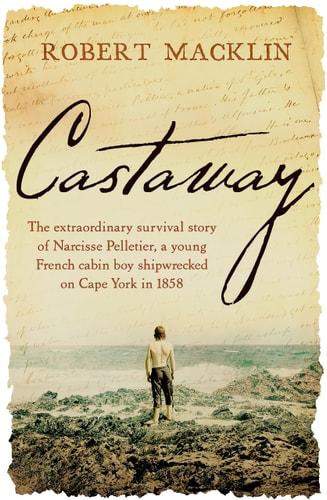
Narcisse Pelletier, aged fourteen, survived a shipwreck off New Guinea, then an open-boat voyage of nearly 1,000 kilometres across the Coral Sea, before being stranded and left for dead on the shores of Far North Queensland. His story is one of extreme physical endurance and the raw instinct to survive against overwhelming odds.

The book's central survival question is: what does a human being need — beyond food and shelter — to not merely survive but to build a new life from nothing?

Connect to books about: maritime disaster, wilderness survival, castaways, true survival narratives.

---

2. **Identity, Belonging & Cultural Transformation**
For seventeen years, Narcisse lived fully among the Uutaalnganu people, growing from a boy into a man within their world. He was given a new name — Amglo — and a new family, culture, language and set of values. When forcibly returned to France, he was torn between two selves.

The book's central identity question is: when a person has lived more of their life in one culture than another, which self is the "real" one — and who gets to decide?

Connect to books about: identity, cultural assimilation, belonging, the self and memory.

---

3. **Cross-Cultural Exchange & Living Between Worlds**
Narcisse's story is one of genuine, prolonged immersion in an Indigenous culture — not as an observer but as a full participant. He learned language, customs, kinship structures and ways of knowing that were entirely foreign to his European origins.

The book asks what it means for a European to truly enter an Aboriginal world, and what is lost — from both sides — when that immersion is violently interrupted.

Connect to books about: cross-cultural encounter, anthropology, ethnography, contact zones, intercultural exchange.

---

4. **Australian Aboriginal History & the Frontier Wars**
Running in parallel to Narcisse's personal story is a broader account of the brutal spread of European settlement in Queensland — the dispossession, massacres, and frontier violence that devastated Aboriginal communities during the same era Narcisse lived among them.

The book holds these two narratives in tension: one man's experience of Aboriginal generosity and community, set against the wider colonial machinery that was destroying those same communities.

Connect to books about: Australian frontier history, Aboriginal dispossession, Queensland colonial history, the Stolen Generations.

---

5. **Colonialism & Empire**
The book is set within the mid-to-late nineteenth century age of British colonial expansion in the Pacific and Australia. European settlement, missionary activity, the pearling industry and the violence of the Queensland Native Police all form the historical backdrop to Narcisse's private story.

The book situates one individual life within the much larger, often brutal forces of empire — showing how colonial power reshapes not just nations but single human destinies.

Connect to books about: British colonialism, settler colonialism, postcolonial theory, Pacific history, empire and its aftermath.

---

6. **Repatriation, Forced Return & Reverse Culture Shock**
In 1875, Narcisse was "rescued" by the crew of a pearling lugger — an act he did not seek and may not have wanted. Taken back to France, he became a lighthouse keeper, married, and lived out his days, all while carrying the memory of the life he had left behind.

The book raises the uncomfortable question of what "rescue" and "civilisation" really mean when the person being saved has already found a full and meaningful life elsewhere.

Connect to books about: repatriation, reverse culture shock, exile, belonging and displacement, the idea of home.

---

7. **Coming of Age & Adolescent Resilience**
Narcisse was only fourteen when he was cast away, making his story simultaneously one of extreme trauma and extraordinary coming-of-age. He grew from a European boy into an Aboriginal man, shaped entirely by the world that saved him rather than the one that produced him.

The book explores how the formative years of identity — adolescence — can be radically redirected by circumstance, and how resilience in young people can take forms that defy expectation.

Connect to books about: coming of age, adolescent psychology, resilience, youth and adversity.

---

8. **History, Memory & the Limits of the Historical Record**
Macklin draws on firsthand interviews conducted with Narcisse after his return to France, alongside other contemporary accounts — yet much of Narcisse's inner life and his years among the Uutaalnganu remains beyond