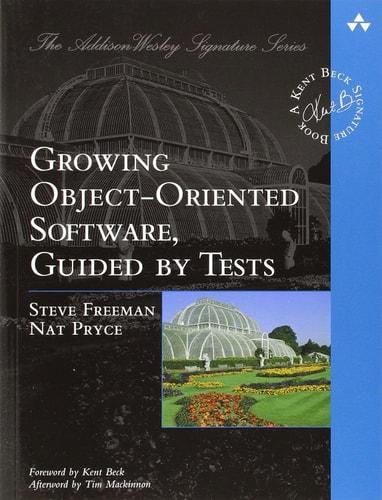
1. **Test-Driven Development (TDD) as a Design Philosophy**
   TDD is treated not merely as a testing technique but as a design discipline — writing a failing test first forces developers to reason about interfaces, behaviour, and intent before implementation. The feedback loop of red→green→refactor becomes the primary engine of software growth.

   The book's central argument is: tests are not a safety net added after the fact; they are the mechanism through which good design emerges.

   Connect to books about: software craftsmanship, extreme programming (XP), clean code, agile development practices.

---

2. **Object-Oriented Design & Emergent Architecture**
   The book treats an OO system as a web of collaborating objects whose collective behaviour is an emergent property of their composition and the messages they pass to one another. Design decisions are not made up front — they grow organically as tests illuminate the right structure.

   The emphasis is on object *communication* over object *state*, pushing developers toward role-based, responsibility-driven design.

   Connect to books about: object-oriented design principles (SOLID), design patterns, domain-driven design, emergent architecture.

---

3. **Mock Objects & the Discovery of Collaborators**
   Mock objects are used not just for isolation in tests, but as a discovery tool — they reveal what collaborators an object needs and how those collaborators should be spoken to. This reframes mocking from a testing convenience into a design practice.

   The book argues that the process of writing mocks teaches you about the contracts and responsibilities between objects before you build them.

   Connect to books about: dependency injection, interface design, software contracts, unit testing strategies.

---

4. **Incremental & Iterative Software Development**
   The book champions building software one small, working slice at a time — starting with a "walking skeleton" that passes an end-to-end acceptance test, then growing features incrementally. No big design up front; the system's shape is discovered through continuous delivery of working code.

   This closely ties the technical practice of TDD to the broader philosophy of agile and lean development.

   Connect to books about: agile methodology, lean software development, continuous delivery, iterative design.

---

5. **Software Maintainability & Sustainable Quality**
   A significant portion of the book addresses how to keep a test suite — and the codebase it covers — readable, flexible, and free of "test smells" over time. Writing tests is easy; keeping them valuable as a system grows is a craft in itself.

   The authors treat long-term maintainability as a first-class concern, not an afterthought, linking code quality directly to the discipline of the TDD cycle.

   Connect to books about: refactoring, technical debt, code readability, software entropy.

---

6. **Acceptance Testing & Collaboration with Stakeholders**
   The book introduces a two-loop model: an outer loop of acceptance tests that capture business requirements and demonstrate progress, and an inner loop of unit tests that guide implementation. The outer loop serves as a communication bridge between developers and customer representatives.

   This positions testing as a shared language between technical and non-technical collaborators.

   Connect to books about: behaviour-driven development (BDD), requirements engineering, agile collaboration, specification by example.

---

7. **Software Craftsmanship & Professional Discipline**
   Freeman and Pryce frame TDD as a craft — something that requires judgment, skill, and practice, not just mechanical rule-following. The book is rich with heuristics drawn from decades of professional experience, positioning software development as a discipline closer to engineering artisanship than factory production.

   The "growing" metaphor itself reflects a philosophy of patient, careful cultivation rather than rapid, brittle construction.

   Connect to books about: software craftsmanship, professionalism in engineering, the pragmatic programmer, developer mindset.

---

8. **Working with External & Legacy Code**
   The book addresses the real-world complexity of building systems that depend on third-party libraries, frameworks, and pre-existing codebases — situations where you cannot simply "write the test first" for code you don't control. It offers strategies for wrapping, adapting, and isolating external dependencies.

   This theme connects TDD to the broader challenge of integrating new practices into inherited systems.

   Connect to books about: legacy code, refactoring under constraints, software integration, the strangler fig pattern.