1. **Evolutionary Biology & Darwin's Legacy**
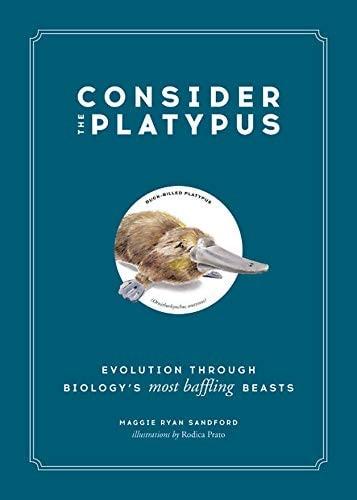
The book uses Darwin's theory as its central framework, tracing how our understanding of evolution has grown and shifted since his original ideas. Sandford revisits what Darwin got right and what he got wrong, giving readers a rich sense of how the field has matured over time.

The book's central argument is: evolution is far more surprising, complex, and strange than Darwin's original model suggested — and the animals that break the rules teach us the most.

Connect to books about: natural selection, the history of evolutionary theory, speciation, the origin of species.

---

2. **Genetics & Genomic Revolution**
A recurring theme is how genetic sequencing has dramatically expanded and sometimes overturned what scientists thought they knew about how life develops and diversifies. Animals like the California Two-Spotted Octopus, which can alter its own RNA mid-lifetime, illustrate how genetics operates in astonishing ways beyond simple inheritance.

The book's underlying argument is: the genomic revolution has not simplified biology — it has revealed layers of complexity that demand entirely new frameworks.

Connect to books about: genetics, genomics, epigenetics, molecular biology, the Human Genome Project.

---

3. **Animal Adaptation & Survival Strategies**
Each animal in the book is a case study in how life finds ways to survive and thrive in radically different environments. From the tardigrade's near-indestructibility to the peppered moth's color shift in response to industrial pollution, the book catalogues the staggering variety of survival solutions evolution has produced.

The deeper point is that "weird" adaptations are not exceptions — they are windows into the fundamental logic of life.

Connect to books about: animal behavior, ecology, biomimicry, extreme survival, natural history.

---

4. **Convergent Evolution & the Patterns of Life**
The book repeatedly returns to the concept of convergent evolution — the phenomenon where unrelated species independently arrive at similar traits or structures. This challenges the notion of evolution as a purely linear, branching story and suggests there are recurring solutions embedded in the logic of life itself.

The central tension here is between the randomness of mutation and the surprising repeatability of evolutionary outcomes.

Connect to books about: convergent evolution, evolutionary developmental biology (evo-devo), patterns in nature, complexity theory.

---

5. **Science Communication & Making Ideas Accessible**
Sandford is a science journalist and comedy writer, and the book reflects that dual identity — pairing rigorous research with wit and illustrated art to make intimidating concepts approachable. The book is as much about how to communicate science as it is about science itself.

This connects to a broader project: science belongs to everyone, and accessibility is not a compromise of rigor but an extension of it.

Connect to books about: science writing, public understanding of science, science education, popular nonfiction.

---

6. **Biodiversity & the Richness of Life on Earth**
By profiling more than 50 species — from sloths and honey bees to lungfish and naked mole rats — the book implicitly makes a case for the extraordinary diversity of life and the importance of studying even the most obscure creatures. Outlier species, it suggests, often illuminate the rules better than ordinary ones do.

The implicit argument is that biodiversity is not just an ecological value — it is an epistemological one, since strange animals expand what we know is possible.

Connect to books about: biodiversity, conservation biology, taxonomy, natural history, species extinction.

---

7. **The History & Philosophy of Science**
The book traces how scientific understanding changes over time — how initial classifications were wrong, how new tools (like genetic sequencing) forced revisions, and how even the platypus was once dismissed as a hoax. Science is presented not as a fixed body of facts but as an evolving, self-correcting process.

The book's implicit philosophical claim is: being wrong is not a failure of science — it is how science works.

Connect to books about: philosophy of science, history of biology, scientific revolutions, Thomas Kuhn, the sociology of knowledge.

---

8. **The Human–Animal Relationship & Our Place in Nature**
Throughout the book, Sandford draws comparisons between featured animals and humans — including a recurring "Fam-O-Meter" measuring genetic similarity to humans — grounding the science in a question readers instinctively care about: what does this mean for us? The book subtly repositions humans as one peculiar species among many, not as the pinnacle of evolution.

This connects to deeper questions about human identity, kinship with other species, and