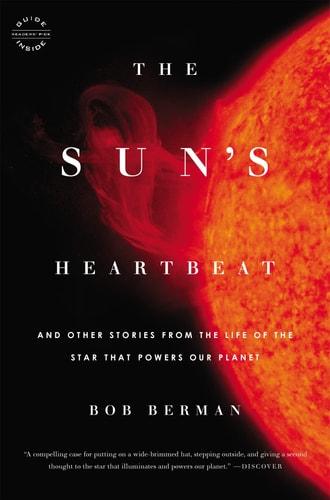
1. **Solar Physics & Stellar Science**
The book is structured as a biography of the sun, tracing its life from stellar birth through nuclear fusion to its eventual death. Berman digs into the physical mechanics of the sun — its composition, energy output, sunspot cycles, and internal structure — making solar science accessible and vivid.

The sun's heartbeat, its magnetic cycles, and the discovery of a "second sun" beneath the solar surface are treated not as dry data but as ongoing mysteries humanity is still unraveling.

Connect to books about: astrophysics, stellar evolution, nuclear physics, plasma science, heliophysics.

---

2. **History & Philosophy of Science**
From ancient astronomers at Stonehenge to Galileo's discovery of sunspots to modern spectroscopy and space observatories, the book maps how human understanding of the sun evolved over millennia. The Copernican Revolution — the shift from geocentric to heliocentric models — is a key turning point Berman explores.

Scientific progress is shown as messy and human, driven by "egotistical battles, laughable errors, and brilliant inspirations" as much as by pure reason.

Connect to books about: history of astronomy, scientific revolutions, philosophy of science, the Copernican model.

---

3. **The Sun's Influence on Earth's Systems**
Berman examines how the sun governs life on Earth far beyond simply providing light and heat — from driving climate and weather patterns to affecting satellite communications, agricultural yields, and even human health. Sunspot fluctuations, for instance, ripple through technology and food production globally.

The book presents the sun not as a backdrop to life on Earth but as an active, dynamic force embedded in virtually every earthly system.

Connect to books about: Earth systems science, climate science, space weather, ecology, energy cycles.

---

4. **Solar Mythology, Culture & Ancient Astronomy**
The book traces humanity's cultural and spiritual relationship with the sun across civilizations — from Egyptian sun gods like Ra, to Greek Helios, to the monument-builders of Stonehenge who oriented their structures to solar cycles. The sun has been revered as deity, symbol of power, and source of divine authority across cultures.

This thread positions the sun not just as a physical object but as a mirror of human meaning-making across history.

Connect to books about: mythology, archaeoastronomy, comparative religion, ancient civilizations, cultural history of science.

---

5. **Climate Change & the Sun's Role**
Berman directly examines the sun's role in Earth's climate, placing solar variability in the context of the modern climate change debate. He addresses the cyclical elements of eccentricity, obliquity, and precession, and situates human agency within the larger solar-driven climate picture.

This makes the book a useful scientific counterpoint to — and complement of — books on anthropogenic climate change.

Connect to books about: climate science, paleoclimatology, environmental science, global warming, Milankovitch cycles.

---

6. **Popular Science & the Wonder of the Cosmos**
Written in an accessible, conversational style, the book is as much about cultivating awe and curiosity as it is about conveying facts. Berman describes phenomena like rainbows, auroras, and total solar eclipses with the goal of rekindling the layperson's sense of wonder at the natural world.

The book belongs squarely in the tradition of popular science writing that treats scientific knowledge as a source of humanistic enrichment, not just technical information.

Connect to books about: popular science writing, science communication, astronomy for general audiences, nature writing.

---

7. **Human Health & the Duality of Sunlight**
One of the book's more provocative threads is the paradoxical relationship between sunlight and human health — the sun both bestows life-giving vitamin D and causes melanoma, and Berman even raises the question of whether the sun may be safer than sunscreen. Ultraviolet radiation and its biological effects are explored in this dual light.

This makes the book a surprising entry point into debates about public health, medicine, and our cultural fear of sun exposure.

Connect to books about: public health, dermatology, vitamin D research, environmental medicine, risk perception.

---

8. **Stellar Life Cycles & Cosmic Time**
The book frames the sun's existence on a vast cosmic timescale — approximately 4.6 billion years old, powered by hydrogen-to-helium fusion, and destined for a dramatic eventual death. This long view invites readers to think about time