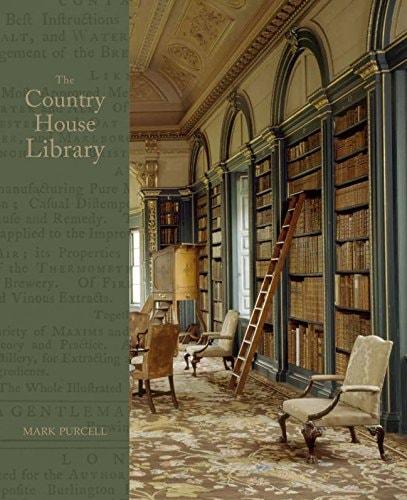
1. **The History & Culture of Book Collecting**
The book traces how private book collecting evolved from Roman-era villas through to the present day, chronicling the obsessive acquisitiveness of bibliomaniacs, the role of booksellers, and the deep personal relationships wealthy patrons formed with their books. Purcell argues that country house libraries were far more actively read and intellectually engaged with than the common dismissal of them as mere status symbols suggests.

Connect to books about: bibliophilia, history of reading, rare books, book collecting as a cultural practice.

---

2. **Libraries as Architecture & Designed Space**
The book examines the library not just as a collection of texts but as a deliberately designed physical environment, exploring how furniture, shelving, ladders, lighting, and room layout shaped how books were stored and experienced. The spaces themselves — from austere scholarly rooms to lavish Victorian leisure rooms with billiard tables — are treated as inseparable from the cultural meaning of the collections they housed.

Connect to books about: architectural history, interior design, the history of domestic spaces, the aesthetics of reading rooms.

---

3. **Class, Power & Cultural Capital**
Purcell links book acquisition across centuries to shifting social hierarchies — from aristocrats and landed gentry to Regency-era bibliomaniacs and fin-de-siècle industrial nouveaux riches. The library functioned as a powerful signal of status, education, and civilisation, with who owned books (and which books) revealing a great deal about how authority and prestige were negotiated across British society.

Connect to books about: the British aristocracy, class and taste, social history of wealth, cultural capital.

---

4. **Heritage, Preservation & National Identity**
The book traces how these libraries gradually became part of a broader national cultural narrative, their survival or dispersal read as a signal of cultural continuity or decline. Purcell discusses the 20th century dispersal of many collections to pay inheritance taxes, and the role of institutions like the National Trust in preserving what remains.

Connect to books about: cultural heritage, conservation, national identity, institutional collecting, the English country house.

---

5. **Bibliomania & the Psychology of Obsessive Collecting**
Acquisition in this book frequently "borders on obsession," with Purcell documenting collectors who amassed books compulsively, rebound precious volumes, and allowed collections to overflow into multiple rooms. The psychology of the collector — their drives, rivalries, and excesses — runs as a thread through the entire history.

Connect to books about: collecting psychology, hoarding, obsession and connoisseurship, the history of taste.

---

6. **British & Irish Social History from the Medieval to the Modern**
The book spans from Roman Britain and medieval manuscript culture through the Reformation, the Civil War, the Regency, the Victorian era, and the 20th century, using the library as a lens through which to read British and Irish social transformation across nearly two millennia.

Connect to books about: British social and cultural history, the English country house, Anglo-Irish history, the decline of the landed gentry.

---

7. **Access, Literacy & the Democratisation of Knowledge**
Purcell reveals that many country house libraries were not purely private: some householders provided books for servants, and some collections informally operated as lending libraries for surrounding communities. This raises questions about who had access to knowledge, how literacy spread, and the porous boundary between private and public intellectual life.

Connect to books about: history of literacy, public libraries, access to education, the spread of print culture.

---

8. **The Material History of the Book**
The book pays close attention to the physical objects themselves — bindings, marginalia, catalogues, illuminated manuscripts, and the physical arrangement of volumes on shelves. The material conditions of books — how they were made, stored, catalogued, and sometimes neglected — are treated as historically meaningful in their own right.

Connect to books about: book history, manuscript studies, the history of printing, bibliography, codicology.