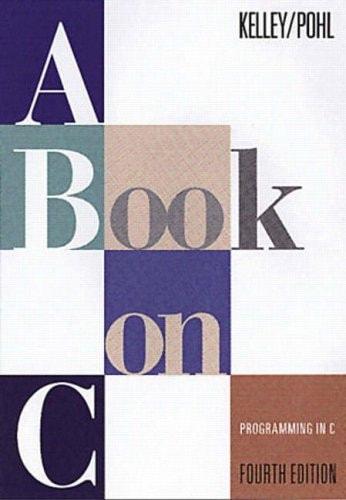
1. **Procedural Programming & Structured Code Design**
   The book teaches C as a procedural language, walking readers through variables, expressions, flow of control, functions, and call-by-value mechanics. The emphasis is on writing clear, well-structured programs in a step-by-step, disciplined way.

   The central idea is that good software begins with mastery of the fundamental building blocks — declarations, control flow, and modular functions — before any higher-level abstraction is attempted.

   Connect to books about: procedural programming, algorithm design, software engineering principles, code style and readability.

---

2. **Memory Management & Low-Level Computing**
   The book devotes significant attention to pointers, arrays, strings, and memory layout — concepts that require the programmer to reason carefully about how data is stored and accessed at the hardware level. Machine-dependent features such as word size and floating-point representation are explicitly discussed.

   This grounds the reader in how software interacts directly with physical memory, a perspective largely absent from higher-level languages.

   Connect to books about: computer architecture, operating systems internals, embedded systems, systems programming.

---

3. **Data Structures & Abstract Data Types**
   Advanced data structuring features — including self-referential structures, unions, enumeration types, ragged arrays, and list processing — are covered in depth. The book also places emphasis on Abstract Data Types (ADTs) as a conceptual foundation.

   The ADT coverage is deliberately designed to bridge the gap between procedural thinking and object-oriented design, preparing the reader for more complex program organisation.

   Connect to books about: data structures and algorithms, object-oriented design, software abstraction, type theory.

---

4. **The ANSI C Standard & Language Evolution**
   The book is grounded in the ANSI C standard and traces the evolution of C from its traditional roots through the standardisation process. It discusses how committee decisions shaped the language — adding void types, function prototypes, and preprocessor improvements.

   This historical and standards-based perspective shows how programming languages are not static artefacts but living systems shaped by community consensus and practical need.

   Connect to books about: programming language design, language standards, history of computing, compiler theory.

---

5. **The C Preprocessor & Metaprogramming**
   An entire chapter is dedicated to the C preprocessor — macros, `#define`, `#include`, and inline code generation. The preprocessor allows programmers to extend and reshape the language's notation and capabilities before compilation even begins.

   This introduces the idea that code can operate on code, a concept that underlies much of modern metaprogramming and template-based design.

   Connect to books about: metaprogramming, compilers and interpreters, macro systems, language tooling.

---

6. **Operating Systems & the UNIX Environment**
   The book explores file structures, systems routines, I/O redirection, interprocess communication, signals, and concurrent processes — all in the context of UNIX and Windows environments. It enables the reader to understand and extend the OS libraries underpinning the system.

   C's intimate relationship with UNIX makes this book a window into how operating systems are themselves constructed, not just used.

   Connect to books about: UNIX/Linux internals, operating system design, systems administration, concurrent and parallel computing.

---

7. **The Transition from C to Object-Oriented Programming**
   The book explicitly bridges procedural C to the object-oriented paradigm, including dedicated material on C++ and Java. It frames C as a stepping stone, showing how the concepts of structs and ADTs evolve naturally into classes and objects.

   This positions C not as an endpoint but as a conceptual foundation — a lens through which to understand why object-orientation was invented and what problems it solves.

   Connect to books about: object-oriented programming, C++, Java, software design patterns, paradigm shifts in computing.

---

8. **Scientific & Numerical Computing**
   The book connects C to applied domains such as numerical analysis, fractal geometry, graphics, and scientific computing. It discusses dynamic allocation of vectors and matrices specifically for engineers and scientists.

   This grounds the language in real-world quantitative problem-solving, revealing C as the engine behind a vast range of computational science tools and simulations.

   Connect to books about: numerical methods, scientific computing, computational physics/engineering, mathematical software.