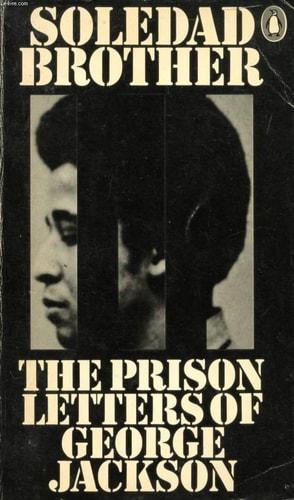
1. **The Carceral State & Prison Conditions**
   Sentenced at eighteen to an indeterminate term of one to life for stealing $71, Jackson spent over a decade in California prisons — seven and a half years of it in solitary confinement — experiencing firsthand the brutality, dehumanization, and racial violence of the American penal system.

   The book forces readers to confront the physical and psychological reality of incarceration: the isolation, the guard violence, the indeterminate sentencing, and the way prisons are used to manage and contain Black political life.

   Connect to books about: mass incarceration, prison abolition, solitary confinement, prisoners' rights, the school-to-prison pipeline.

---

2. **Race, Racism & Systemic Injustice in America**
   Jackson's letters are a sustained indictment of white supremacy as it operates through institutions — the courts, the police, the prison system — and against ordinary Black life. He argues that racism is not incidental but structural, embedded in the economic and legal foundations of the United States.

   His case — charged with murder on slim evidence, widely believed to have been targeted for his political views — exemplifies how the justice system disproportionately criminalizes and punishes Black Americans.

   Connect to books about: systemic racism, civil rights, racial justice, the criminalization of Blackness, Jim Crow and its afterlives.

---

3. **Marxism, Revolutionary Politics & Anti-Capitalism**
   In prison, Jackson immersed himself in Marx, Lenin, Mao, and Fanon, developing into a committed Marxist-Leninist who argued that capitalism was the root cause of Black suffering in America. His letters trace a political radicalization from personal grievance to revolutionary theory.

   He came to believe that violent revolution was the only meaningful path to liberation, placing him in a long tradition of anti-colonial and anti-capitalist thought.

   Connect to books about: Marxism, revolutionary socialism, anti-colonialism, Frantz Fanon, capitalism and race, Third World liberation movements.

---

4. **The Black Power & Black Panther Movement**
   Jackson became a member of the Black Panther Party while incarcerated, and his case became a defining cause célèbre of the Black Power era — alongside figures like Angela Davis, Huey Newton, and Malcolm X. The book sits at the heart of 1960s–70s Black radical politics.

   His letters document the intersection of prison organizing and street-level political movements, and his story helped shape the broader demand for Black liberation and self-determination.

   Connect to books about: Black Power, the Black Panther Party, Black radicalism, Angela Davis, Malcolm X, civil rights militancy.

---

5. **Self-Education, Intellectual Transformation & the Life of the Mind in Captivity**
   Rather than being broken by confinement, Jackson transformed himself through voracious self-directed reading in politics, economics, history, philosophy, and languages. His letters chart the emergence of a formidable intellect forged entirely behind bars.

   This arc — from a young man with a "record" to a leading theoretician of the prison movement — raises profound questions about what education is, where it happens, and who is denied access to it.

   Connect to books about: autodidacticism, prison education, intellectual biography, literacy and power, self-reinvention.

---

6. **Family, Love & the Emotional Toll of Incarceration**
   The letters are addressed to Jackson's parents, his younger brother Jonathan, Angela Davis, and his lawyer — and they reveal the deep emotional cost of imprisonment on family bonds. Jackson struggles to communicate across the wall between his world and theirs, and to maintain connection despite radically divergent experiences.

   The book is also a portrait of a mother and father trying to hold their son through correspondence alone, and of a brother who would ultimately die trying to free him.

   Connect to books about: incarceration and family separation, epistolary literature, grief, Black family life, parenthood under duress.

---

7. **Political Prisoners, State Repression & Resistance**
   Jackson and the other Soledad Brothers were widely seen as political prisoners — men targeted not for proven crimes but for their militancy and organizing inside prison walls. The book raises enduring questions about when the state uses criminal prosecution as a tool of political repression.

   His story connects to a global tradition of dissident writing from captivity — from Gramsci to Nelson Mandela — in which the