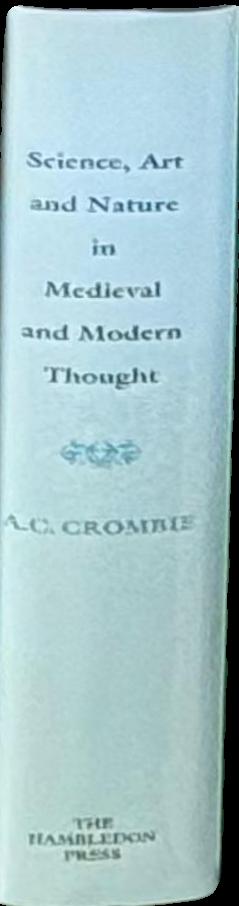
**A.C. Crombie's "Science, Art and Nature in Medieval and Modern Thought" explores the history of Western science as a continuous argument and vision that began with the ancient Greeks' search for fundamental principles of nature and reasoning 【1】【2】.** The book emphasizes the interplay between science, art, and nature throughout history. 【3】【4】
Key themes and topics in the book include:
* **The Aristotelian Inheritance**: The book traces the influence of Aristotelian thought on the development of science, particularly the emphasis on logical explanation during the Middle Ages 【5】. To connect with other books, look for works on Aristotle's philosophy, medieval science, and the history of logic.
* **Experiment and Quantification**: Explores the rise and limitations of experimental methods and quantification in scientific inquiry 【5】. This theme connects to books on the history of scientific methodology, the philosophy of science, and the development of statistics.
* **Changing Attitudes to Scientific Progress**: Examines how ideas about scientific progress have evolved over time 【5】. This theme can be linked to books on the sociology of science, the history of technology, and the philosophy of history.
* **Continuity Between Medieval and Modern Sciences**: Highlights the connections between scientific thought in the medieval period and the modern era, with discussions of figures like Roger Bacon and Galileo 【6】. This theme links to books on the history of medieval science, the Renaissance, and the Scientific Revolution.
* **The Role of Mathematics and Platonism**: Discusses the significance of mathematics and Platonic ideas in the development of science during the 16th century, particularly within Italian universities and Jesuit educational policies 【4】. This theme connects to books about the history of mathematics, the philosophy of mathematics, and the influence of Platonism on scientific thought.
* **Galileo Galilei's Natural Philosophy**: Explores Galileo's early natural philosophy, his ideas of science and nature, and his use of rhetoric 【3】【4】. This theme links to biographies of Galileo, studies of his scientific work, and books on the relationship between science and rhetoric.
* **The Interplay between Vision and Argument**: The book emphasizes how scientific vision is explored and controlled through argument and how both are diversified by scientific experience and interaction with broader intellectual contexts 【7】【8】. This theme connects to books on epistemology, the philosophy of science, and the history of ideas.